Noun Pronunciation: XXX Literally, “cold milk.” Milk that is no longer warm from the cow and is beginning to undergo fermentation in the lmala.
When kule nairewa (milk fresh from the animal and thus warm) cools, it becomes kule nairobi.
Kule nairobi is used after it begins to ferment in the lmala, a period of hours that varies by seasonal temperature and geography. In Wamba, Kenya, it generally takes three to four hours after milking to reach the kule nairobi stage. Depending on the weather, and in a freshly smoked lmala, it would take less time in a warmer climate at a lower elevation from Wamba, like that of Archers Post (just one day), and more time in higher elevations, such as Marsabit and Maralal (four to five days).
You can make tea with kule nairobi until it shifts to a later stage of fermentation, kule naisukutan.
“It does not make the tea taste sour. It is still nairewa (fresh) and supati (good).” — Robin Leparsanti in conversation with William Rubel, Feb. 1, 2016.
Noun Pronunciation: XXX. Newly collected milk warm from the animal and somewhat sweet. Most Samburu people do not drink kule nairewa because it is kong’u (smells of cow) and has not yet acquired the desirable flavors from fermentation in a lmala.
Kule nairewa, as with all Samburu milk, is consumed either from a small lmala into which the animal is milked, or from a container into which the milk was transferred.
Murran (warriors) drink kule nairewa while out with the animals when they are too far from a manyatta to get fermented milk from a home. Otherwise, fresh milk is only consumed by elders — all of whom are by definition men. From the fresh milk, elders can tell a great deal about the herd and the state of the forage. Through the subtleties of mouthfeel, they can taste how far the animals are from the start of lactation, and from taste and aroma they can tell what plant or plants the animals have been eating.
To Samburu people, the dominant smell and taste of kule nairewa is of the sweat or basic smell of the animal — thus, the smell of cow, goat, sheep, or camel. While fresh milk can be used to make chai (tea boiled with milk and sugar), when milk was plentiful, most tea was made with kule nairobi, a stage in which milk has absorbed taste and aroma from the lmala but has not yet soured enough to curdle when mixed into a hot liquid, as it will at the next stage, kule naisukutan.
“Straight from the cow, it can give you an upset stomach. You need two or three hours to cool.” — Robin Leparsanti, in conversation with William Rubel, Feb. 1, 2016.
The fermentation process begins with the lmala container being cleaned with burning botanicals. Kule (milk) is added to the container and then the milk goes through stages of fermentation; if left too long, it goes bad. The Samburu people of northern Kenya have traditionally fermented milk from their animal herds in containers made of wood or gourd, known as lmala (singular) and lmalasin (plural).
The stages of milk fermentation, from fresh to rotten, proceed in the following order:
Kule nairewa – fresh and warm from the animal
Kule nairobi – cooled and beginning to ferment
Kule naoto (alternatively, kule kowoto) – ripened and ready to drink milk
Kule naisukutan – flavor shifts from sweet to sour
Kule naishicho – sour milk
Kule nataroitie – milk that has gone bad but didn’t fully sour
Kule ntorok – rotten milk
Explore Samburu words about milk fermentation
Each link below will take you to an in-depth description of the term, including a pronunciation guide, and how the word relates to milk fermentation.
I encourage you to begin with kule to gain a basic understanding of the importance of fermented milk in Samburu culture.
Noun Pronunciation: kah-mah-nang True buttermilk; uncultured buttermilk. Kamanang’ is the whey that is produced after churning cream or, in this case, the curds.
The Samburu consume kamanang’ fresh, fermented, or lightly boiled. If consumed fresh, kamanang’ is in the same class as kule nairewa. Depending on how the lmala has been prepared, the fresh milk may or may not have picked up flavor from the burning sticks used to sterilize the container. When fermented, kamanang’ can be kept in the lmala for roughly one week, until the white milk comes [What is “white milk”? Leave your answer in the Comments below].
Adjective Pronunciation: XXX Ripened milk that has fermented and is ready to drink.
Kowoto describes milk at the point it has soured; is no longer liquid; and has formed a soft, supple product similar to yogurt but more delicate. This is the most esteemed stage for fermented milk, the point at which the milk is most balanced. The term is applied to all animal milk except for camel.
Noun Pronunciation: koo’-lay General term for milk. It can be cow, sheep, goat, or camel, and there is no assumption that kule refers to one type of milk over another.
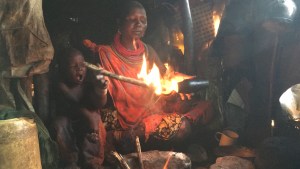
A Samburu woman cleans the interior of a lmala with a burning stick chosen for the flavor profile it will impart, and a small amount of water to create steam.
This Samburu word will trip up outsiders, whose understanding of milk is limited to liquid that has been transferred fresh and unfermented from the dairy herd to a processing plant, and then homogenized and pasteurized for storage in waxed cardboard boxes, glass bottles, or plastic pouches. The processing plant will also adjust the milk fat so that a standard amount ends up in the finished product — whether “whole milk” or “skimmed milk” in American English. Milks that are “ultrapasteurized” tend to have a slightly different taste, and even texture, than less radically treated milk products. Dairy products tend to be derived from pasteurized milk. So, butter, cheese, kefir, and yogurt are all children of milk that basically went from dairy to industrial processing equipment that transformed the raw milk to cooked milk, and then on to an industrial system that distributed that product in different ways to different manufacturers.
The kule of the Samburu — and this also applies to all remaining Kenyan pastoralists, not just Samburu people — is a milk that went from dairy herd to lmalasin (wooden or gourd containers for milk fermentation) that had been made clean enough to handle milk by being heated and steamed with burning sticks and water. The latter would have been selected by the woman of the house, as all production is house-based and conducted by females for keeping qualities and flavor profile.
For all practical purposes (exceptions being exceptions), the Samburu do not drink milk directly from their animals. Thus, all Samburu milk products are fermented to one degree or another. Even kule nairobi — milk that has been in the container just long enough to become nairobi (cold), though not yet noticeably fermented — will have picked up taste and aroma from the lmala in which the milk was stored. How much taste and flavor is picked up depends on the botanicals that were used to clean the container and the woman’s lmala cleaning style. While I did not personally taste the lmala the last time I drank what was without question one of the most delicious cups of milk I have ever tasted — a cup of kule nairobi camel milk — I suspect a more sophisticated palate would have. What I tasted was a notable depth of flavor. Many Samburu can identify the time from initial lactation, the season, and the animal’s pasture from the taste and aroma of the milk.
The cheeses, butters, and yogurts are now a thing of the past in my research area — the Samburu Lowlands, centered on Wamba. This said, in trying to imagine the milks and milk products described in this vocabulary, you need to substitute phrasing like “smoke-cured and fermented milk” for “milk.”
My own Samburu milk journey began through a glass that I drank in the lightless interior of a manyatta hut on the full moon night of my return to Samburu in 1992. I had read an anthropologist’s report about the Samburu. The anthropologist said that milk was the staple food of the Samburu. What I tasted that first night in the cup of milk passed amongst us was a beverage so deep, complex, and enticing — sweet, with a slight vanilla ice-cream flavor and an ineffable smoky taste — that I was shocked. This was not “milk” in any sense of how I understood the word. I immediately wondered how this had been created, and the next morning began my quest to find out.
A language analogy would be a claim published in a peer-reviewed paper that the primary French adult beverage is grape juice — but fermented grape juice is not grape juice, and fermented milk is not milk. In English, fermented milk is kefir, yogurt, butter, or cheese. In Samburu, it is kule nairewa, kule naoto, kule naisicho, kule nataroitie, and so on.
Noun Pronunciation: XXX Milk a wife sets aside for her elpayan (husband) when he is away on a journey, so that it is available for him to drink immediately upon his return.
Depending on the length of the elpayan’s time away from home, the milk will be more or less sour. The elpayan must share the milk with another elder, because drinking this milk alone is taboo, thus, kule mparan is the only milk that a married man may not drink alone.
As of this writing, August, 2023, Idris is collecting seeds for trees and is planting in preparation for the October rainy season. Current seedling quantities are are limited by water.
Examples of seedlings in stock for the upcoming rainy season”
200 avacado
100 mango
250 Kayapa (tree used for fencing)
70 Local mahogany
150 Lmarggwet (cottonwood)
150 black passion fruit
40 papaya
40 Marubaine (three with 40 medicinal uses)
Vegetable crops
50 pili pili peppers plus more coming along
Many Skuma (kale)
A variety of flower seedlings are also available at the nursery.
Idris Lekaria, director of the Memita Disables Tree Nursery and Creativity Center in Wamba, Kenya, announces the opening of a school for young children in a village remote from a school. The teachers are trained teachers, but without work. The students are hungry, so the school will both provide education and food. If you would like to assist financially with this project, please use the contact form. Thank you.

 Samburu Research