Noun
Pronunciation: koo’-lay
General term for milk. It can be cow, sheep, goat, or camel, and there is no assumption that kule refers to one type of milk over another.
This Samburu word will trip up outsiders, whose understanding of milk is limited to liquid that has been transferred fresh and unfermented from the dairy herd to a processing plant, and then homogenized and pasteurized for storage in waxed cardboard boxes, glass bottles, or plastic pouches. The processing plant will also adjust the milk fat so that a standard amount ends up in the finished product — whether “whole milk” or “skimmed milk” in American English. Milks that are “ultrapasteurized” tend to have a slightly different taste, and even texture, than less radically treated milk products. Dairy products tend to be derived from pasteurized milk. So, butter, cheese, kefir, and yogurt are all children of milk that basically went from dairy to industrial processing equipment that transformed the raw milk to cooked milk, and then on to an industrial system that distributed that product in different ways to different manufacturers.
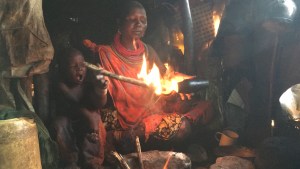
The kule of the Samburu — and this also applies to all remaining Kenyan pastoralists, not just Samburu people — is a milk that went from dairy herd to lmalasin (wooden or gourd containers for milk fermentation) that had been made clean enough to handle milk by being heated and steamed with burning sticks and water. The latter would have been selected by the woman of the house, as all production is house-based and conducted by females for keeping qualities and flavor profile.
For all practical purposes (exceptions being exceptions), the Samburu do not drink milk directly from their animals. Thus, all Samburu milk products are fermented to one degree or another. Even kule nairobi — milk that has been in the container just long enough to become nairobi (cold), though not yet noticeably fermented — will have picked up taste and aroma from the lmala in which the milk was stored. How much taste and flavor is picked up depends on the botanicals that were used to clean the container and the woman’s lmala cleaning style. While I did not personally taste the lmala the last time I drank what was without question one of the most delicious cups of milk I have ever tasted — a cup of kule nairobi camel milk — I suspect a more sophisticated palate would have. What I tasted was a notable depth of flavor. Many Samburu can identify the time from initial lactation, the season, and the animal’s pasture from the taste and aroma of the milk.
The cheeses, butters, and yogurts are now a thing of the past in my research area — the Samburu Lowlands, centered on Wamba. This said, in trying to imagine the milks and milk products described in this vocabulary, you need to substitute phrasing like “smoke-cured and fermented milk” for “milk.”
My own Samburu milk journey began through a glass that I drank in the lightless interior of a manyatta hut on the full moon night of my return to Samburu in 1992. I had read an anthropologist’s report about the Samburu. The anthropologist said that milk was the staple food of the Samburu. What I tasted that first night in the cup of milk passed amongst us was a beverage so deep, complex, and enticing — sweet, with a slight vanilla ice-cream flavor and an ineffable smoky taste — that I was shocked. This was not “milk” in any sense of how I understood the word. I immediately wondered how this had been created, and the next morning began my quest to find out.
A language analogy would be a claim published in a peer-reviewed paper that the primary French adult beverage is grape juice — but fermented grape juice is not grape juice, and fermented milk is not milk. In English, fermented milk is kefir, yogurt, butter, or cheese. In Samburu, it is kule nairewa, kule naoto, kule naisicho, kule nataroitie, and so on.
Return to Stages of Milk Fermentation.
This is the draft manuscript of the Samburu Milk Project, © 2024 William Rubel.

 Samburu Research