This is a draft definition from my Samburu Research dictionary of culinary taste and texture terns.
Kadadai, adj. Dilute almost to the point of absolute tastelessness. 1:5 Milk to water is kadadai. Applies to anything that is so dilute there is basically no nutritional value in the dish. For example, a watery porridge or a “meat” soup in which the meat content is so small it is basically not there. Past kadadai, the dilution is ulaash.
Samburu woman cleaning a lmala — milking container
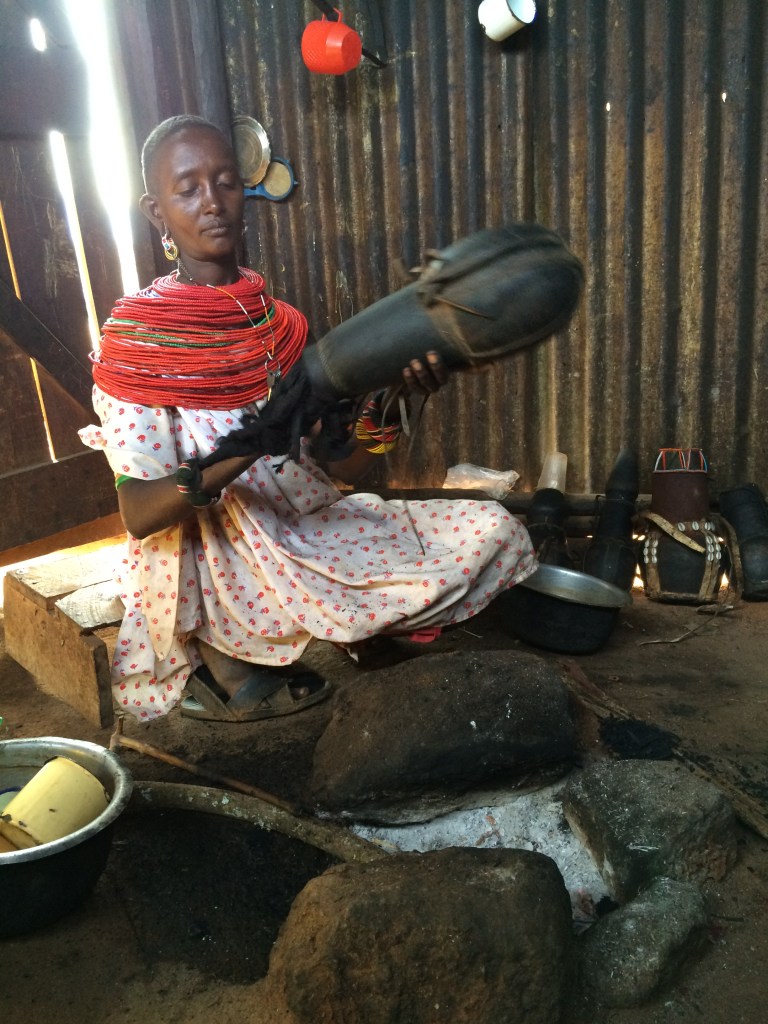
The Samburu do not like milk with bits of ember or ash in it. Other tribes in the region serve milk with black specks from the process of sterilizing with burning sticks, so preference for a milk that is totally clean, totally white when poured , which is how most of the world prefers the milk, in this context is a cultural preference amongst the Samburu. Their white milk – and the milk will be left in the lmala to ferment to one of their preferred stages of consumption – differentiates it from some of the milks from other nearby tribes, like the Turkana.
This woman, and I apologize for forgetting her name, is the wife of Chief Stephen Loldepe. I have stayed with her. They live in a concrete house. This is an outdoor kitchen retaining the three rock kitchen fire emplacement common to the manyatta stick huts.
Samburu have long been semi-nomadic pastoralists, so their traditional buildings can be disassembled, with the larger stick used for the hut framework can be re-used. This is a modern outdoor kitchen with tall galvanized walls.
Making Lmala, Samburu Milking Containers


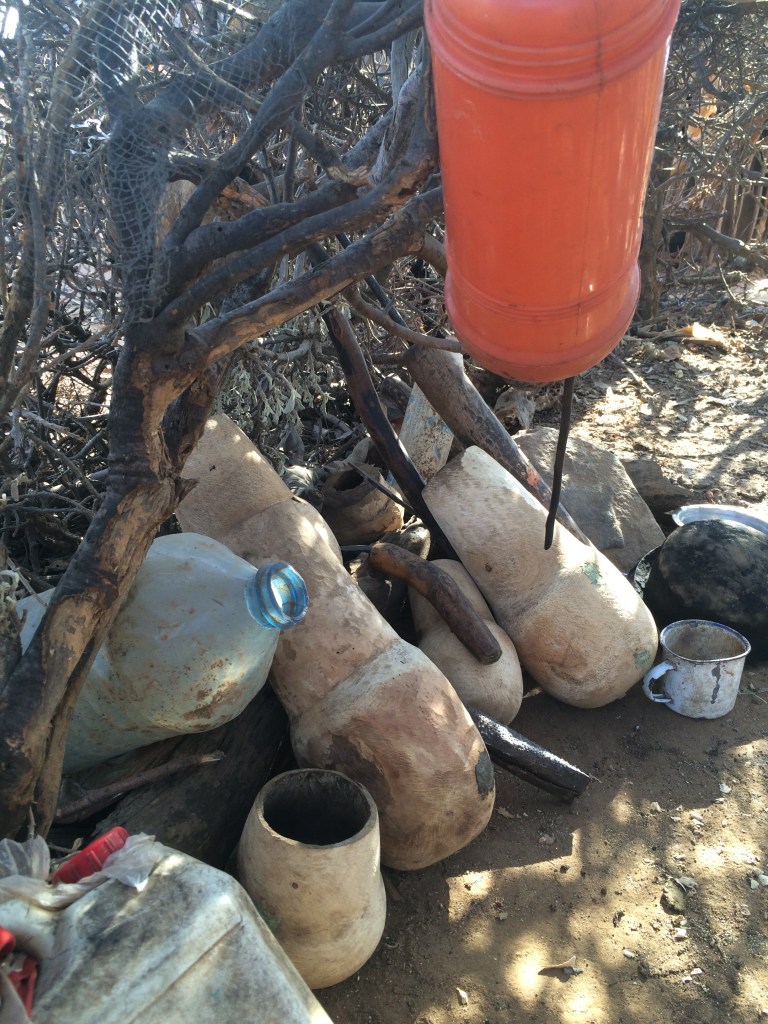

We see here one gourd container in the upper left image, but all the others are made of wood. I took the photos of unfinished lmala in 2018 as I was walking around the manyatta in the West Gate Conservancy, where I was staying. The inside is carved out by softening the wood by burning with embers and then scraping the ash with a shallow spoon-shaped carving tool forged by a local blacksmith. Very thin walls and elegant containers are crafted using this carving system.
The Samburu-English travel Dictionary

This Samburu travel dictionary is a bi-lingual English to Samburu dictionary that travelers will find useful when visiting Kenya’s Samburu region. The Samburu and Maasai are closely related cultural groups. They share Maa as a common language, though there are some differences between Maasai and Samburu speakers. This dictionary is technically English and Northern Maa.
The Samburu tribe of Northern Kenya is a semi-nomatic pastoralist culture although the collapse of the local Savannah grassland ecosystem has largely ended pastoralism in the Samburu Lowlands.
Maa does not have a robust written tradition. Besides the bible, there are virtually no published texts in Northern Maa. I developed this dictionary to help me converse with the people I was staying with for the month I was in Kenya in the Summer of 2022. While everyone who has gone to school speaks English, many people, especially older women, but also some young men, are not school-educated. They will probably speak Swahili, but if you don’t, then you will find this dictionary to be invaluable.
People appreciate it when you use words from their language, so I encourage you to keep this dictionary handy. Researchers will find that if you use at least some Maa, even though you have a translator, that you will find more acceptance. Learning the words that prertain to your area of study is also, of course, useful.
If you are a tourist and not familiar with the area at all, the largest town in the Samburu Lowlands is Wamba, which is where I recorded this dictionary, and the biggest city is Maralal, which is located in the Samburu Highlands.
If you have any corrections or additions you’d like to see me incorporate into the dictionary, then please leave a comment. Thank you.
Carol Fabert July 2022
The Northern Maa Culinary Dictionary

Words preserve culture. Over a period of fifteen years, with the help of dozens of friends in the Samburu Lowlands near Wamba, Kenya, I have created a culinary dictionary with as fine a level of cultural detail as I was able to achieve. The level of cultural detail I have been able to achieve is unusual in dictionaries. In this instance, I think that I am able to show that within subsistence cuisines in which the diet consists of a handful of ingredients, or only one, that there is much more than meets the eye of the outside viewer. Through this dictionary project, I have done my best to preserve for the Samburu themselves cultural knowledge that is rapidly being lost. I am also offering outsiders a glimpse into what was an exceedingly subtle cuisine centered on what I refer to as smoke cured fermented milk. This is milk fermented in wooden containers sterilized by burning sticks. The tradition of smoke cured fermented milk is not unique to the Samburu — it is a practice shared by many pastoralist traditions within other Kenyan tribal group, even amongst the Kikuyu. The Samburu, however, are amongst the last East African groups who were able to maintain their traditional milk cuisine in its full complexity until relatively recently.
I began working on the Samburu milk cuisine in 1994. It was a vastly richer practice then, than it is now, although even then it will have been diminished by the first of the devastating droughts that began in the early 1970s.
I do not speak Maa. This dictionary was written with the help of Samburu who speak both Maa and English. Every entry has been read by many people. I kept what seemed to have a consensus behind it.
The local Savannah acacia-grassland ecosystem has collapsed. The land no longer even supports goats. With the collapse of the ecosystem that supported pastoralism, Samburu Lowlands pastoralists can no longer live on the land. The entire world of smoke-cured fermented milk, historically the single most important Samburu cultural food, is passing into memory. Young people have little to no experience with smoke cured milks. It has been years since there were cows in the Lowlands. It has been hard to ccess to daily supplies of cow milk, the Samburu milk of choice.
The anthropological literature concerning the Samburu tends to report that “milk” is their staple food (or was), at which point the literature tends to move on to something else. In this, the anthropological literature tends to let us all down – the Samburu and outsiders alike.
To say that “milk” is the staple food of the Samburu is like saying that grape juice is the primary alcoholic drink of the French. Milk is the ingredient in Samburu smoke-cured fermented milk, exactly as grape juice is the ingredient in French wines. The depth and complexity of the Samburu culinary vocabulary is astounding. I suspect that other cultures with beverages at the core of their diet will also have a complex culinary vocabulary.
The Samburu milk tradition is centered on fermentation. Milk from cow, goat, sheep, or camel, are milked into fire-cleaned and smoked hand carved vessels, lmala. Everything about the experience of consuming a milk-based fermented beverage is encoded within their language.
Smoke cured fermented milk is alive, as are all actively fermenting foods. The taste and texture of the milks being fermented change as fermentation progresses, shifting from sweet to neutral to sour. At the same time, the milk’s texture thickens. To a Samburu there are many more aspects of taste and texture beyond the stages of fermentation. I have tried to record the Samburu vocabulary that is used to talk about food — one of us human’s favorite pastimes.
Because milk, a beverage, was the Samburu staple, they have an exceedingly detailed and subtle culinary vocabulary. There are words for taste and texture concepts that we do not have in English. As of 2023, the dictionary of culinary terms, along with related vocabularies, is in a final draft form. I have other projects in front of this, so I will probably not complete the manuscript for publication before 2025.
Here is a sample entry:
Kebebek [adj]. Used to describe a thin mouthfeel or to milk diluted with water. The oppostie of keirucha. By nature, this is a relative term. Comparing milk textures, camel is the most kebekek followed by cow, sheep, and goat. Milk texture changes seasonally. For example, cow milk, always less kebekek than camel milk, is seasonally perceived as kebekek when rainy season fodder naturally dilutes its texture. The strongest diluting effect is felt from the Spring “little rain” that fosters strong growth of tender leaves in shrubs, rather than from the “big rain” in late autum and early winter which has a more immediate effect on the grasses. When new growth supports lots of milk, then that milk will be kebebek. Elders monitor the condition of forage from their manyatta homes in part through changes in milk texture as plants adjust to the natural wet and dry cycles of the Northern Kenyan interior climate. The first milk from the cow is kebebek compared with the more keirucha, thick milk, that follows in two to three weeks. Goat milk is made more kebebek for one or two milkings when, after one week on the lkees, range, they are finally taken to water. The diluted milk of unscrupulous market women is kebebek. Chai (tea, milk, water, and sugar) that is more dilute (1:4 milk to water) than the standard recipe (1:2) is kebekek. Ill people may ask for their tea kebekek; as may people who simply prefer it that way.
Nkirrau, Nkirau

Note: this is a draft. Please let me know if you have comments, suggestions, or pictures.
A gourd calabash with a flat-topped cup lid similar in style to the mala enkoriong. The dried gourd is purchased from the Maasai. This is a storage, not a milking container. If you want fresh milk, kule nairobi, then you clean it first, but if you want kule nuato, you don’t clean the nkirrau. The gourd is used by anybody.
 Samburu Research