My Samburu milk journey began in the lightless interior of a manyatta (hut or collection of huts) on a full-moon night in 1992. I was hooked as soon as I sipped my first mouthful of smoke-cured and fermented milk prepared by the mother of my friend, Lawrence Letua. What I tasted that first night in the cup of milk passed amongst us was a beverage so deep, complex, and enticing — sweet, with a slight vanilla ice-cream flavor, and an ineffable smoky taste — that I was shocked. This was not “milk” in any sense of how I understood the word. I immediately wondered how this had been created, and the next morning began my quest to find out.
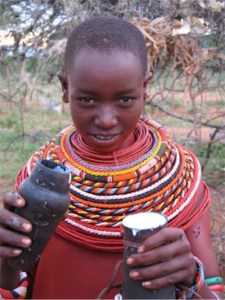
The Samburu Milk Project and its website are the product of 30 years of research. Working with Longhiro Lekudere and other now-friends living in or around Wamba, Kenya, we collectively made our best effort at documenting this extraordinary culinary tradition. As the tradition itself relied upon pastoralism for its existence, and as the combined catastrophes of climate change and overgrazing have destroyed the land to the point that pastoralism is no longer practical in this part of East Africa, what is described here is largely a culinary tradition that is no longer being practiced. It is my hope that the Samburu community will find this document helpful in retaining something of their ethnic identity as they shift from being pastoralists to being Kenyans.
Origins
I first saw the Samburu Lowlands around Wamba, Kenya, in 1991, but I consider my first real visit to be in 1992, when my mycologist friend David Arora proposed a six-month trip to Africa starting in April. While I wasn’t able to do that, I could manage a few weeks the following August. I was enamored of an idea in John Cage’s book A Year from Monday, in which he made a mushroom foraging date with friends for a year from a particular Monday. So, David and I agreed to meet at 6 p.m. on August 15 in the bar at the New Arusha Hotel in Tanzania. The guidebook from which we got the rendezvous point also mentioned one could get to Arusha from Nairobi by riding in the DHL van that made the journey every weekday. Imagine: So few packages for Arusha that DHL could fit them, plus tourists, into a basic white Toyota van!
And so, without any further contact between us, I showed up, David showed up, and we had adventures. We eventually made it to Wamba, a town in the Samburu tribal area, for an afternoon and an overnight stay. We attracted a dozen or so boys who followed us to a cafe, where we bought tea for the group. Mushrooms are never far from David’s thoughts, so we asked about mushrooms.
Had I come to Wamba just six or seven years earlier, I would have seen an ecology in which humans and animals still maintained a kind of balance. Elephants, rhinos, antelopes, and giraffes still roamed the outskirts of the village. But when I first came to the Samburu Lowlands, it had only been 30 years since travel controls were lifted after the British retreat from Kenya, when colonial rule ended in 1963. One still encountered a military checkpoint on leaving Isiolo. People traveling the 100 kilometers north to Wamba moved in a caravan with a fixed time for changing flat tires. My recollection is the convoy moved again after 20 minutes, with or without you. The territory of Wamba was more secure than areas further north, but once we did have an army gun traveling with us. Effectively, there were no police and no Kenyan government, but there were missionaries and the tail end of the U.S. Peace Corps program that helped people in poor regions. I am now certain the land would have looked stressed to me had I had prior experience of the first great modern droughts — in 1972, 1984, and 1986 — that must have left their mark. But for a first-timer, this acacia savannah was similar in many ways to the oak savannah of my Central California, with widely spaced evergreen trees above grassland.
Smoke-Cured and Fermented Milk
The Samburu have a highly sophisticated culinary vocabulary (see Milk Taste and Texture Terms), one that includes a number of words to express subtleties of taste and mouthfeel that we do not have in English, or, so far as we know, in any European language. The roughly 20 types of differently shaped, sized, and decorated milk containers (see Types of Milk Containers — Lmalasin) are each assigned to individual age groups, genders, and cultural purposes. The drinking and serving of cow milk has traditionally reinforced the Samburu social structures, including that of the murran (warrior) age set.
Processing milk starts with a female producer making a lmala (a lmala is a single milk container; lmalasin is the plural). Most lmalasin are wood, with a beautiful smooth, black exterior achieved through a fine sanding, followed by coloring with black paint made by mixing ash and animal blood, or ochre. Gourd lmalasin often have a rich, golden-brown glow. All lmalasin are vessels for storing and fermenting fresh milk, and all have a lid or cap. Samburu do not drink milk directly from the lmala, but pour it into the cap, which also serves as a cup.
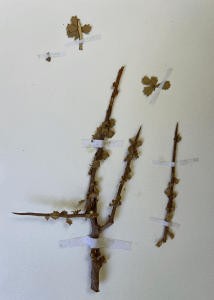
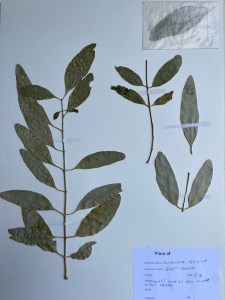
Before its first use, the interior of a lmala is prepared with a burning stick (see Botanicals for Lmala Preparation). The interior is first rinsed with water to dampen it, and a small amount of water is retained within the lmala. Next, burning botanicals are added; many women place entire burning sticks inside the lmala, while others light the end of the stick and stir it inside to break off its embers. The presence of agitating both water and embers inside the container creates dense smoke and steam. The lmala is capped until the process of sterilization is finished, indicated by a hiss of steam issuing from the container when the cap is removed. The woman then wipes the interior of the container clean, and it is ready to receive fresh milk. Below is a video of a Samburu woman sterilizing a lmala, filmed by my daughter.
The botanicals burned within the lmala are critical to the final taste of the milk stored inside, as is the tool used and the technique employed to clean the residual ash from the container’s interior. Tradition dictates that containers should be sterilized with botanicals after each use. The burning sticks are selected by the woman of the house, as all production is house-based and conducted by females for its keeping qualities and flavor profile. Only nkalani (slovenly) women do not frequently clean their lmalasin, and this sloppiness will affect the quality of the milk stored within.
For all practical purposes — exceptions being exceptions — the Samburu do not drink milk directly from their animals. Thus, all Samburu milk products are fermented to one degree or another. Even kule nairobi — milk that has been in the container just long enough to become nairobi (cold) after milking, though not yet noticeably fermented — will have picked up taste and aroma from the lmala in which the milk was stored over the next few days. See Stages of Milk Fermentation for detailed information on the stages of creating smoke-cured fermented milk.
Climate Change and Cultural Devastation
During my 2022 trip, in the year of my 70th birthday, I observed that the collapse of the Samburu Lowlands milk culture was nearly complete. It was a shock for me to return after a three-year hiatus due to the Covid-19 pandemic to find the land dead. I had been documenting changes to the landscape and ecosystem for years, but was caught totally unprepared by what I found. I had long understood this part of the world to be a canary in a coal mine. For years, I had been telling friends that the close link between ecology and pastoralism made the Samburu Lowlands a unique testing ground, because the lost grazing habitat would mean the collapse of pastoralism — where we would see the relationship between ecological collapse and cultural collapse. I was not prepared to see there is no longer a point in asking when pastoralism would end, because pastoralism had already ended. In July, 2022, everyone I met who had a plot suitable for even some minimal planting was actively talking about taking up farming.
Cheeses, butters, and yogurts were a thing of the past. Commercial milk was being sold in bags in every shop. This was a change, even from the previous summer. The village market demands fresh milk — no taste or aroma from the botanicals used to prepare the wooden containers, and none of the flavor and textural complexities of fermented milk. My friends who are acquiring affluence no longer produce fermented milk from their animals, nor do they buy it from pastoralist women. The shift to plastic milking containers is accelerating. Plastic containers eliminate all Samburu culture-specific milk tastes and textures, all types of traditional milking containers, and most of the Samburu culinary vocabulary. They require no skill to prepare — just a rinse with water — so an entire craft tradition is being lost.
I didn’t see a single murran (warrior) in full dress. Virtually everyone in Wamba wore Western dress. Women with beads around their necks were scarce. My host and a few of his friends and relatives, looking through my photographs, said they had forgotten the names for the different types of lmalasin. Another friend told me he was surprised recently to find that one of his children didn’t know the name for “shin” in the Samburu dialect.
To be Samburu is to live with your animals, and to consume milk fermented in smoke-cleaned lmalasin. Urban Samburu lose their taste for traditional milk. Who is a Samburu who doesn’t drink tribal milk? Who is a Samburu living in Nairobi? Several elders to whom I posed this question answered, “A Kenyan.” Not a Samburu.
I wish I could tell you that the story of Samburu milk is one of thriving culinary tradition imbedded within a thriving community, but I cannot. I interviewed a new acquaintance, Pasqual, about what it was like in the Samburu Lowlands in 2022. Towards the end of the interview, he asked me a Job-like question — unanswerable, poignant, painful, and haunting: “What is this climate change? Nobody told us about this climate change.” And he ended with the words, “There has never been a drought like this one.”
Only gravel lay under the tree canopy of the Matthews range during my visit in the summer of 2022. There is no longer anything stopping the rainwater from flowing, and most areas are victims of sheet erosion, in which the entire hillside is covered in water a couple of inches deep flooding at high velocity toward erosion gullies. It is now possible to kill oneself by stepping off the edge of a gully — many are that tall. The shrubs that exist are those not eaten by goats and sheep. Cows have not been able to survive for about ten years. Now, it is camel land. The few people with remaining animals were performing habitual actions — as no pasture existed, the only way to feed one’s goats was to shake the acacia seeds out of the trees. That trick works from April to August — one shakes and shakes, pulling down the ripe seeds each time — but then the food dries up. Then, the only forage to cut for goats comes from trees in the mountains (illegal, and you need to be near the mountains), or forage trees growing in dry river beds (you need to be near the dry bed and deal with elephants, and this forage isn’t sustainable). The tiny herds people manage don’t produce enough milk even for tea, much less for a glassful. There is virtually no economic point in having 6 to 12 goats. Yes, the animals can be thought of as being fungible with money — if you need money for school fees, you can raise the money by selling a goat at one of the weekly markets. (A small female goat goes for 4,000 shillings, roughly $35 USD at the 2022 exchange rate.) But when you sell a goat and you only have six, or even a dozen — and such herds are now few and far between — you have lost an animal that could reproduce and provide milk.
There is no plan B. The American writer, Malcolm Gladwell, popularized the idea of the tipping point. The Samburu Lowlands are one tipping point in a world of tipping points— abnormal Arctic and Antarctic temperatures, melting of glaciers, the drying up of lakes Meade and Powell in the U.S., huge forest fires in Eurasia and North America, and many similar events. What I offer here is just one story from a remote East African valley. In the words of John Donne, “Ask not for whom the bell tolls, it tolls for thee.”
Explore the Samburu Milk Project
Use the following links to explore content collected through the Samburu Milk Project.
Dictionary Methodology and Acknowledgements
Stages of Milk Fermentation
Milk Taste and Texture Terms
Types of Milk Containers — Lmalasin
Botanicals for Lmala Preparation
The Culture of Milk — Idioms and Expressions
Other Samburu Words
Milk, Music, and Religion — scheduled completion in late 2025
Milking Songs — scheduled completion in late 2025
This is the draft manuscript of the Samburu Milk Project, © 2024 William Rubel.
If you are Samburu and have corrections or suggestions to make, please use the comment field at the bottom of each page.



 Samburu Research