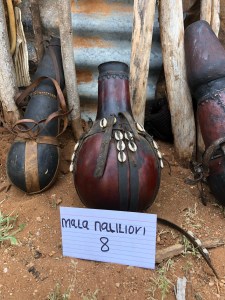
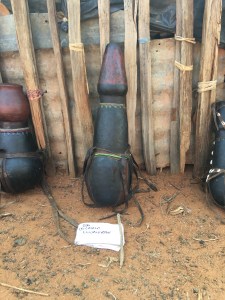
Noun Pronunciation: XXX Ceremonial name used for a medium- to large-sized lmala nklip when it is carried by the best man in a wedding procession. It is usually used to store sheep fat.
The naililiori its carried by the best man at a wedding, with one strap wrapped around his wrist and his fingers over the lid. On the second day of the wedding ceremony, the husband, best man, and bride (in this order) walk out of the bride’s manyatta through her father’s gate. They step over a band of grass her father has strewn across the doorway to mark the transition. Traditionally, the procession moves with slow, stately steps until they reach the husband’s manyatta. (See lmala enkoriong for a description of how lmalasin are used in a wedding ceremony.) After the wedding, the lmala naililiori is once again used as an nklip.
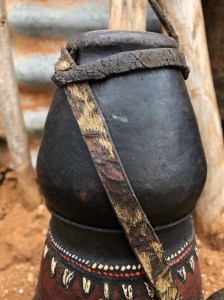
Made from a gourd, the naililiori has colored bands ending in small triangles woven in at its neck. This holds in place a leather lip that fits the conical cup. The lmala nkirau is identical to the naililiori except it has only a single side band running up from the base to the waist belt.
Description
Capacity: XXX liters
Cylindrical vessel made from a gourd, with a conical cup-shaped leather lid. The vessel’s long, straight sides swell outward gently below its neck to a swollen, rounded base. The vessel’s exterior is often stained red with ochre and decorated with skirai (cowry shells). Decorative leather stitching at its neck secures a leather collar. The removable leather cup is slightly wider and bulbous at its base, and flat on the top.
A wide vertical leather strap runs up the from the center bottom of the vessel and is held in place by two wide leather straps along the waist. It is not uncommon for the straps to retain some animal hair or to be decorated with cowry shells. The detached lid is roughly cup-shaped, with sides that slope outward below a rounded top to a low, rounded waist, then taper sharply at the bottom to fit over the vessel’s neck. The lid also can be painted black or ochre-stained, but is otherwise undecorated.
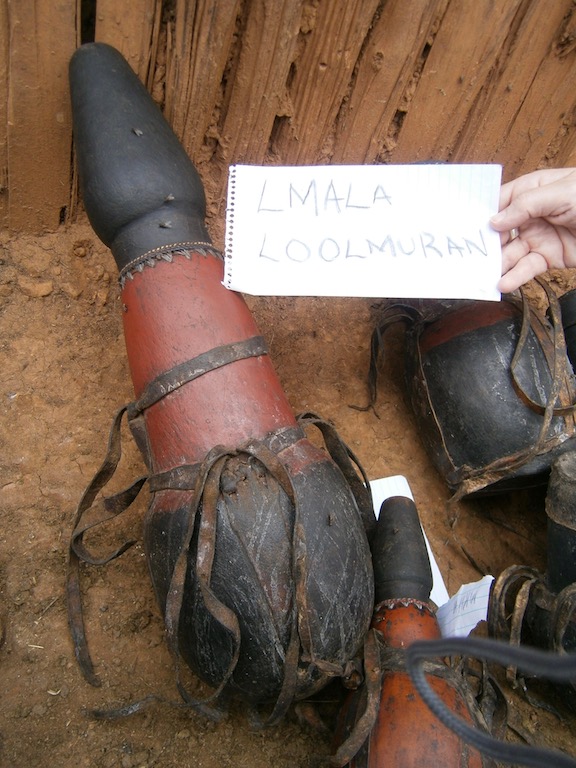
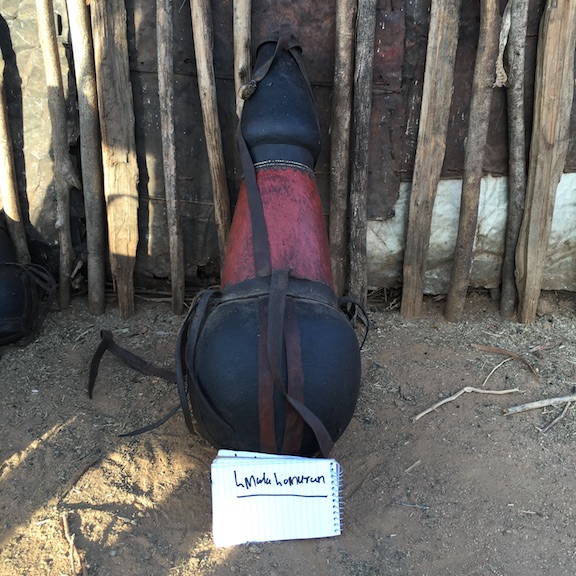
Noun Pronunciation: XXX The only lmala the murran (warriors) drink from. A very large wooden lmala with a hollow cup that also acts as a lid.
The loolmuran is an nklip and has that group’s basic shape — a bulbous base, and a straight section that is at least as long as the bulbous portion and usually a little longer. The stitching pattern holding the leather in place at the neck into which the wooden lid is tightly fitted is the same as for the nklip and other lmalasin, except in this unique case, the color of the bottom triangular-shaped stitching is green. In Samburu culture, green is associated with boys, unlike in many Eurocentric cultures, where blue is associated with boys and pink with girls.
Because the loolmuran is so large, it is made of a lighter wood, such as bolorio. As with the lmala seenderi, the wood on the loolmuran‘s lid and its straight neck section are often colored red with ochre. The color and pattern are not prescribed. The neck and cup can be read as a phallic shape; the lid, which fits into a leather sleeve, is shaped like the tip of an erect penis. A lmala loolmuran is larger than a typical nklip. Its leather carrying straps are never decorated, so it projects a sense of raw strength and power.
When milk was plentiful before the beginning of the modern drought cycles in 1972, a loolmuran’s capacity could be as large as 10 liters. Today, the average size is about 5 liters, but it can also be smaller, because it is defined by its shape and decorations and not its size. Since it is so large, the loolmuran is made of a lighter wood, such as bolorio.
Before being circumcised, boys wear a sainanyori (single-strand necklace of small, green glass beads). One finds a sainanyori around the necks of babies at about six months, just as in Mexican culture, for example, girl babies get their ears pierced. One knows a Samburu infant is a boy in the same way one knows a Mexican infant is a girl — by their jewelry. After the initiate boy has been circumcised and is led back into his mother’s hut for his penis to heal, the first thing that happens is that the sainanyori is removed from his neck and slipped over the neck of the lmala loolmuran [Is there a loolmuran in every mother’s hut, or just in the warriors’ huts? Leave your remarks in Comments below]. It stays there for seven to 10 years. No ceremony exists for removing the sainanyori. At some point, the mother decides it is time to remove it, typically after the boy has grown a lot and is transitioning to the next stage in life, which is as an elder.[What happens to the sainanyori after the boy becomes an elder? Leave your remarks in Comments below]
Description
Capacity: 5 liters on average
Cylindrical wooden vessel with an urn-shaped wooden lid. The vessel’s long, straight sides swell outward gently below its neck to a bulbous rounded base ornamented with carved designs. The vessel’s exterior is painted black or stained red with ochre, and it has decorative leather stitching in white and green at its neck that support a leather collar. Leather carrying straps of varying widths encircle its sides at the waist and support the base. It is not uncommon for the straps to retain some animal hair. The separate carved wooden lid is roughly urn-shaped, with sides that slope outward below a rounded top to a low, rounded waist, then taper sharply at the bottom to fit over the vessel’s neck. The lid also can be painted black or ochre-stained, but is otherwise undecorated.
Noun Pronunciation: XXX Big, round, and squat-bottomed lmala with a bulbous base and a bulbous, flat-topped lid, used to store milk inside the hut. A smaller version of the lkantir is called nkantir e ruat kini.
An lkantir container is carved of wood and has stitching at the top to attach the leather flange for the lid. The container’s neck is drilled with small holes, which are then stitched with multiple woven bands of colorful thread. The stitching design typically has woven triangles that point downwards. As with all lmalasin, the lkantir has leather carrying straps that may still retain some animal hair, and may be decorated with skirai (cowry shells). The exterior of both container and lid are usually painted red (ochre) or black (ash mixed with animal blood).
This lmala stays inside the house. As it is not taken out of the house for milking into, it must be filled from another lmala. Its primary function is to store milk for the murran (warriors). They drink the milk while sitting in the men’s section of the nkang (the manyatta house). When warriors come into the manyatta, they check the lmala loomuran (the container that is dedicated to their use). If the loolmuran is empty, they will pour milk from the lkantir into it.
As herd sizes have collapsed, Samburu room plans are changing. In 2022, it was possible to enter an nkang and not find a communal male sleeping area or section for communal feeding. Today (2024), this system has collapsed. Not only don’t the Samburu have milk from their own animals, but they now fear the murran (warriors). As we were editing this entry with our translator, Longhiro Lekudere, in February, 2025, at one point he had to run to a safer spot because of stray bullets from a quarrel between murrans. One person was injured. It was too dangerous to walk home, so Longhiro stayed in lodging in the town.
The flat top of an lkantir lid.
Lkantir lid, with bulbous base of the container in the background.
Is this a nkantir e ruat kini (small version of an lkantir)?
Description
Capacity: XXX liters
Cylindrical wooden container with urn-shaped wooden lid. The vessel’s sides swell outward below its neck to bulbous shoulders, then taper to a rounded base. Part of the exterior is often stained with ochre. Decorative leather stitching at the top of the container is used to secure a projecting leather collar that serves as a flange to support the lid. Leather carrying straps of varying widths encircle the container’s sides at the waist and support the base. The straps may retain some animal hair. The detached carved wooden lid is roughly urn-shaped, with sides that slope outward below a projecting top to a swollen rounded base, and then taper sharply inward again to fit inside the container’s leather flange. The lid is typically undecorated except for black or red paint — blood mixed with ash for the former, and ochre for the latter.
Noun Pronunciation: XXX Ceremonial name for a small nklip decorated with skirai (cowry shells) and used by a bride at her wedding. She carries it on her back on the second day of her wedding. After the ceremony, the enkoriong once again becomes an nklip used by girls and women.
The enkoriong is carved of wood. It has a long neck that swells from the top The long urn-shaped lid, also carved from wood, is detachable and serves as a cup.
This bride’s lmala must be naasho (free of blemishes, and without cracks or repairs), marking it as a ritual object. If her mother doesn’t have an existing one that meets the standard for a wedding, then her mother will make a new one or she will purchase one from a specialist.
The enkoriong comes into ritual use on the second day of the wedding, when the bride is already married. She must separate from her mother and go to live with her husband. Depending on family culture, the bride may be ritually dressed in skins by her mother and other female relatives outside the door of her mother’s ngaji (house) within the manyatta compound. The enkoriong is strapped to the bride’s back as the last piece of traditional wedding garb. She may be given a milk-filled lmala nkirau to carry, or she may bear both an enkoriong and an nkirau— one on her back and the other in her arms. Milk plays a central role in this portion of the wedding ceremony.
The bride begins a ritual walk by moving slowly towards the father’s gate — the gap in the acacia thorn fencing that is the entrance to the ngaji (her mother’s house). Her father will have made a line of cut grass on the ground, marking the separation between the manyatta and her unmarried state on the inside, and her husband’s manyatta and her new life-state as a married woman on the outside. Her husband and his best man wait for her just outside the gate.
With the husband leading, followed by the best man carrying a lmala naililiori filled with milk, the three begin a slow procession to her new home and the completion of the marriage ceremony. The three (bride, groom, and best man) stop before ending their slow walk, when they are still very close to the bride’s birth manyatta. They kneel, and the best man, who is carrying a milk-filled small naililiori(one usually used to store sheep fat), pours milk into its cap, and hands that cap to the bride who then feeds him the milk. He replaces the cap, they stand, process a little more, kneel, and then the best man puts milk into the cap and feeds it to the bride, who takes the cup back and replaces the cap. They then continue the procession in silence. The bride is fed in this way three more times. The procession can take a day or two at a ceremonial pace.
After these four feedings are completed, the three stand and proceed on foot or by any conveyance they can afford — motorbike, a mattatu, land cruiser — to the husband’s manyatta. The one separation ceremony I observed took place in 2018, at the marriage of a girl about 12 years old (the age of my daughter, who was with me on the trip). The wedding was bathed in the child’s screams. Customs are changing, so the procession on foot continued only three-quarters of the way around the manyatta, at which point the bride got on a motorbike behind her husband. The best man filmed everything for Facebook.
After the husband’s family makes a ceremonial donation of gifts to the bride, such as bracelets, beads, and animals — each presented with a ceremonial name, thus one doesn’t say, here is a bracelet, one says here is flama, by way of analogy in authorial imagination — the bride distributes the milk from her lmala to the assembled children. Then she goes into her husband’s newly built house, where she is met by her mother-in-law and other new female relatives, and they drink tea.
And so, finally, the young woman, after some small details, becomes married in accordance with ancient Samburu tradition. Until very recently, some brides would never return to visit their mother’s family. (As the Samburu were semi-nomadic, this “return” was not to a specific piece of ground, but rather to the manyatta where the mother’s ngaji was located, wherever that might be.) Even if the woman did return for a visit, it was for a brief meeting and took place 10 to 20 years after the wedding ceremony.
Description
Capacity: about 1/2 liter
Cylindrical wooden vessel with an urn-shaped wooden lid. The container’s long, straight sides swell outward gently below its neck to a swollen rounded base. The bottom is rounded. At its top, the container narrows slightly to a neck topped with holes stitched with colorful threads ending in colorful triangles; the stitching holds in place a leather collar or flange that supports the lid. The lid, which also serves as a cup, fits inside the leather flange. The lid is also cylindrical and roughly urn shaped, a little broader at the bottom than at the top, which is flat. The leather carrying straps are decorated with cowry shells and are about the width of these shells. One strap is attached to the lid. The cowry shells are attached to the long strap in a vertical orientation so the center of the shell is parallel with the side of the strap, while the strap that circles the top of the bottom is oriented perpendicular to the edge of the strap. It is not uncommon for the leather straps to retain some animal hair.
The vessel’s exterior is painted black (animal blood mixed with ash) or stained red with ochre, or both. The lid also can be painted black or ochre-stained, but is otherwise undecorated.
Noun Pronunciation: XXX A small or medium lmala with a skin cup used for milking, drinking, or as a child’s lmala.
The enkoiting looks almost identical to a naitu [Should this be spelled “nyatio”? Leave your remarks in Comments below], but can be distinguished by its narrower base. If there is an enkoiting being used for children, then its leather straps are undecorated, while if it is used by elders, its straps will be stitched with skirai (cowry shells). A murran (warrior) will never drink from this lmala.
The white of the cowry shell surrounding its center reminds Samburu of the white fat that surrounds the heart of the animals they butcher. (As with many cultures, the Samburu associate the heart with love.) As a sign of love, the wife stitches skirai on the straps of the enkoiting she makes for her husband.
Description
Capacity: XXX
Noun Pronunciation: Small or medium-sized calabash with a skin cup/cap used for milking, drinking, or as a child’s lmala.
Cylindrical wooden vessel with a detached lid. The vessel’s straight sides swell outward gently below its rim to a slightly swollen, rounded base with a flat bottom [Is this correct? Leave your remarks in Comments below.] The vessel’s exterior is painted black. Leather carrying straps of varying widths encircle its sides at the waist and support the base. The separate lid is often a plastic cup. The lid also can be painted black or ochre-stained, but is otherwise undecorated. [Is this description correct? Leave remarks in the Comments below.]
Noun Rel. lmala kini enkerai, n. Pronunciation: ehn’-ghee-ahr-ee-eye
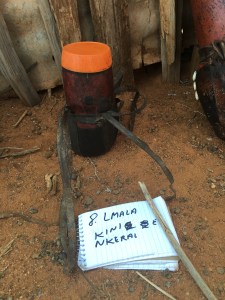
The nkerai is a class of lmala that includes the enkoriong, the woman’s wedding lmala. That becomes the kini enkerai when a girl child reaches the age of six or so and needs more milk than the nkerai — after weening until they need more milk at a serving.
This group of lmalasin is reserved for boys once they are old enough to start drinking cow’s milk.
The small lmala that accompanies a bride becomes her child’s lmala. But normally the first newborn uses lmalanaitu, which have a skin cup rather than a wooden cup. Children first from the skin because they don’t know how to drink without pouring milk.
The enkerai is among the smallest vessels in the nkoiting class of lmalasin. Enkerai come in two sizes: the lmala enkerai, with a capacity of about 500ml, and the lmala kine enkerai, which is equivalent to the sippy cup I gave to my infant daughter.
Enkerai are milk containers for infants of about six months, as they begin to supplement their mother’s milk with lmala milk. The lmala nkerai is used until the child’s appetite increases to the point an nklip or larger is more practical.
Description
Capacity: about one glass of milk
Cylindrical wooden vessel with a cup-shaped plastic lid. The vessel’s short, straight sides swell outward gently below its waist to a rounded, slightly swollen base.
The vessel’s exterior is painted black or stained red with ochre. Leather carrying straps encircle its sides at the waist and support the base. The separate lid is roughly cup-shaped, with sides that slope outward below a flat top, and fits over the vessel’s neck. The lid also can be painted black or ochre-stained, but is otherwise undecorated.
Lmalasin are the large homemade containers in which the Samburu of Wamba, Kenya, have traditionally stored and fermented milk from their herds (cow being the most significant, but also goat, donkey, and camel). Each lmala is fitted with a lukupuri (lid over the vessel’s neck that also serves as a drinking cup).
Lmala is singular; lmalasin is plural. In its plural form, the word is the collective term for all wooden or gourd miking containers holding a minimum of two liters. Plastic containers, lepirra, are not currently included under the lmalasin rubric. A mala is smaller than two liters, and thus smaller than a lmala. Without a modifier, mala has the general meaning of “a small container.” To clarify which container is meant, there must be a modifier, such as mala naililoiri.
Every Samburu woman knew how to carve and decorate the different lmalasin. Specialist lmala producers once existed, so a typical lmalasin collection might include acquired pieces. The typical household collection reflected household dynamics, growing as the herds and family increased, and decreasing as the family itself matured — no need for so many lmala for infants if there were no infants. The collection also changed as herds declined.
The interior of each lmala is cleaned with fire before use, and then the container is used to ferment milk. (The video below shows how a Samburu woman cleans a lmala with burning botanicals and steam.) The botanicals used to cleanse the lmala interior will impart distinctive flavors, and also influence how long the milk will remain usable before becoming kong’u (rotten, bad).
While the word lmala is usually translated into English as “calabash,” only a few lmalasin are actually made from gourds. Most of the 20-plus milking containers used in the context of Samburu milk production are carved from wood by women. The majority of the different container types are reserved for use by specific genders or ages.
See the Introduction for a complete discussion of the lmala’s role in Samburu culture. My study also has some application to the milk cuisines of neighboring pastoralist cultures, such as the Pokot, the Rendille, and the Turkana.
Explore Samburu words for milk containers
The links below will take you to photos and in-depth descriptions of each type of lmala, including decoration and use. The containers are organized by basic type. Each group shares design elements and shapes of the lmala named in the heading.
Nklip–naitu group lmala naitu – for children and women lmala enkoiting – for milking, drinking, or as a child’s lmala lmala naitu elpayan – a husband’s naitu made by his wife when they are first married lmala naitu nang’orchiereki – a smaller naitu for the measure of one collection of blood bled from a cow for mixing with milk to make kule njuloti and kule saroi lmala naitu elayiok – a boy’s lmala carried when the cattle move away from the manyatta
Nairoshi-lkantir group lmala nairoshi – for collecting milk; can be used by anyone lmala lkantir – stays inside the house; stores milk for murran (warriors)
Nkirau group (gourds) lmala nkirau – can be used by anyone except murran (warriors) lmala nyatio – gourd for churning ngorno (butter) lmala naililiori – carried by the best man in a wedding procession
Seenderi group(skin bottom) lmala seenderi– stores milk for the elpayan (husband) lmala nkodoos – collecting container for milk, meat, or butter
Ngoiti (flat bottom) lmala ngoiti– to collect blood from a cow lmala nkerai – container for boys old enough to drink cow’s milk
Lmala Preparation and Decoration These links will take you to words for making, ornamenting, and cleaning lmalasin (milk containers).
Making and decorating the lmalasin kerarang’u – bleaching the lmala ldupasoroi – wood for decorating the lmala lkaria – ochre for decorating lodo – blood for painting loriesi’e – scraper for lmala preparation lorise le oriong – tool for lmala preparation lorise lu nochuaa – tool for lmala preparation lpirra – plastic cup ltuda – sewing needle lukupuri – carved wooden cap or cup lwierset – tool for lmala preparation mparuai – thread nbita – tool for making wood objects nchoni – skin raanita – skin straps saasaa e atua – small grater for lmala interior saasaa e oriong – long grater for lmala exterior skirai– cowry shells used in lmala ornamentation
Cleaning the lmalasin airr – process of cleaning the lmala after use musuti– rag for the final stage of lmala preparation sosian – stick used in lmala preparation
XXX – Is there a word for the woven band? [Leave your remarks in Comments below] XXX – Is there a word for the decorative stitching on the lmala? [Leave your remarks in Comments]
More
Use the following links to explore additional content collected through the Samburu Milk Project.
Adjective Pronunciation: Utterly and absolutely tasteless, like water.
Chai, porridge, or soup where the main ingredient has become an “ingredient,” because its taste profile can no longer be detected. This could be a 1:6 (milk to water) chai, or porridge that has no ingredient besides unga (maize flour) and water, but the preparation is so thin that it is basically water.






 Samburu Research