This work is dedicated to the many dozens of Samburu who, over a period of thirty years, took care of me, guided me, patiently answered my questions, reviewed manuscript entries over and over and over again. Thank you.
This work documents a culinary vocabulary of taste, aroma, and mouthfeel that far exceeds that of English, and I suspect nearly all other languages. The food itself, the smoke cured fermented milk, has been dismissed by observers from outside Kenya with two reductionist observations. The anthropological literature observes that the Samburu staple food is (was) milk. Travelers with published accounts of visiting the region going back to the 19th century have observed the Samburu drink “smoked milk.” In fact, the Samburu cuisine of smoke cured fermented milk is a cuisine of incredibly complexity and subtlety. And their Northern Maa vocabulary of taste and texture terms is exceedingly complex. Speaking as an English speaker, I can say that there are a large number of culinary ideas that the Samburu can discuss that we have no words for – or concepts. An example is xxxx, tasteless, and xxx, lacking its essence.
The Samburu smoke cured fermented milk is the quintessential poverty food that is dismissed by outsiders as a nothing.This work is dedicated to the generations of Samburu women whose lives revolved around preparing the milking container with burning sticks, a skill they began learning as small children. The work is tedious. It is also harmful to ones health. Eye and lung problems go hand-in-hand with the milk preparation.
Just before electricity came to the Wamba area I described a refrigerator to Elizabeth, one of the women who taught me how to make the milk, and who I stayed with on many occasions, even though we could not directly speak to each other. Through a translator, I described a refrigerator to Elizabeth. I told her that would keep milk cold so that it would last for a week or more. I asked her whether, if she had such a box, she would still clean the containers with burning sticks. Without any hesitation, “No.”
This work is dedicated to all of the Samburu women, and all of the women everywhere, in all times and places who, living lives with few material possessions created meals for their families with limited ingredients for which they were taken for granted. Their labor and skill assumed by their families and communities, and their work entirely over looked by outsiders who looked down on their foodways as too simple to bother with. It is to you that this work on one of the quintessential cuisines of poverty is dedicated.
The Samburu milk cuisine, infinitely nuanced, consists of the skill and connoisseurship of generations of women going back to the time of myths who skillfully created foods of distinction using wooden and gourd containers for production, selected botanicals to sterilize the containers, flavor and to preserve the milk, milk, of course, and time.
And, personally, this is dedicated to my mother under whose guidance I learned to pay attention to taste, aroma, and presentation. The skills I needed to recognize in my first sip of Samburu milk that there was a treasure passing between my lips.
As soon as I had sipped my first sip of smoke cured and fermented milk prepared by the mother of my then friend, Lawrence Letua, I was hooked. It was my first night of my first return to Wamba, Kenya. 1994. I had disembarked from the roof of Baby’s Coach, the one vehicle that connected Wamba with the rest of Kenya via Isiolo and Archer’s post. With the Mathews Range to our right, for hours we bumped and crawled along the road, finally reaching Wamba in flurry of air horn music as the sun was setting in early evening. Every night being and early night so close to the equator. In the dark, there was no electricity in Wamba, and at that time flashlights were not common. There was a moon. We walked in the moon light to his mother’s stick and dung hut. I was ushered through the narrow low door, narrow so one had to bend and slide through at an angle, and was told where to sit in the pitch black interior. No lights of any kind. The hut a few meters in diameter and low. Only children can stand. I was not able to see the other people. Dark skinned people sitting it the dark. We made our introductions and then a hand handed me a wooden cup of milk. I sipped. And that was it. That was love at first sip. Such a delicious lightly smoked ineffably sweet taste, something like vanilla ice cream and a mouth feel that was not that of fresh milk, not a fully clabbered yoghurt, not the thickness of a cultured Kiefer, a mouthfeel that few of us have ever encountered, a milk with body, light, refreshing, with an utterly beguiling taste.
I returned to Wamba nearly every year between 1994 and Covid, sometimes skipping a year, sometimes going twice. Since Covid, I have been back once, for my 70th birthday. I went back to finish this manuscript and to celebrate my birthday within the community I had developed a deep connection. I had five-hundred guests — one hundred of which were children — including a row of dignitaries — the wives of regional politicians who sat in seats in front of where everyone else was gathered, staring straight ahead, like people at a high table, which is what, in fact, they were. Around a dozen men and women came together in that summer of 2022 to help me complete the dictionary, the identification of the botanicals used in the processing of milk, and the containers into which milk was milked and/or fermented. This work can be understood as a community effort – the Samburu community working with me to document the pride of their culinary culture — a central aspect in how Samburu identified themselves.
Times have changed. In the past, the field anthropologist would travel to a place, come back to their home, write it up, publish, and that was that. The many people who helped me with this project now all have phones. Several of them are people with whom I have maintained a relationship. There are also now large online communities of Samburu. We are posting this material towards the end of 2024. Throughout 2025 we will be working with people still living in Samburu County and living in the Samburu diaspora in other parts of Kenya, and the world, to correct errors and add details. The life that this work describes is no more. Between climate change and over grazing, the land no longer supports large herds, or even any herds of cows, and for so many right now, not even goats or sheep. Only camels. The countryside is depopulated. Manyattas, small collections of stick and dung huts are a rarity, now mostly associated with the outskirts of a small town, a school. It has been a long time since people have had the daily experience of drinking well prepared cows milk. Or even the experience of a single cup of milk in a year. Memories are fading.
If you are Samburu and have anything to add to this work, or have corrections you’d like to make, please use the comments. If you’d like to speak with me, then let me know in your comment. The smoke cured and fermented milk cuisine of the Samburu is one of the world’s great milk cuisines. Together we can document it as it was, and then it will at least have a chance to find a new expression as the Samburu melt into the larger culture of Kenya, and the world.
Adjective
Pronunciation: kohng’-oo Stinky; bad smelling. Negative term.The opposite of koropili (smelling nice).
Kong’u foods may be unpleasant to consume, but they are still consumable, unlike foods that are so rotten they are keisamis.
Kong’u is used to describe an uncleaned lmala, one that is due for cleaning and thus quickly causes milk to sour and clot. You can see the lmala is due for cleaning because the milk inside is clotting. [Is the following statement correct?] When an nkalani (dirty) woman’s lmala is cleaned and then used, the interior (instead of returning to black) is coated with a white-ish-yellowish film, somewhat analogous to the ring that forms in a bathtub, but likely biologically active. This film gives the milk of the nkalani woman a bad taste.
The lmalasin of most murran (warriors)living on their own in the bush tend to be poorly prepared or haven’t been cleaned properly for a long time, and thus become kong’u. (The murran tend to clean the lmala with cow urine.)
Milk kept in plastic containers quickly becomes kong’u, often in as little as one day. This milk tastes even worse than that from a dirty lmala.
More generally, kong’u can be used to describe the smell of rotting meat, fruit, or cabbage, and can also be applied to meat from a very old animal that has a strong smell, for example, from an old he-goat.
Pasteurized milk from shops becomes keisamis (totally inedible), rather than kong’u.
“When you use the urine to clean the calabash, the milk becomes bad, bitter, like a lemon (kodua). The murran do it in the bush because they don’t have time to clean the calabash, so they’re usually using the cow urine just for the day. But the milk becomes kodua. We use the urine to wash our hands in the manyatta. The calabash is not cleaned with urine in the manyatta, only by the men in the bush.” — Longhiro Lekudere in conversation with William Rubel, January 15, 2025.
Adjective Pronunciation: keh-beh-bek’ Used to describe a thin mouthfeel, or milk diluted with water. The opposite of keirucha.
By nature, this is a relative term. Comparing milk textures, camel is the most kebekek, followed by cow, sheep, and goat.
Milk texture changes seasonally. For example, cow milk, typically less kebekek than camel milk, is seasonally perceived as kebekek when rainy season fodder naturally dilutes its texture. The strongest diluting effect is felt from the spring “little rain” that fosters strong growth of tender leaves in shrubs, rather than from the “big rain” in late autumn and early winter, which has a more immediate effect on the grasses.
When new growth supports lots of milk, then that milk will be kebebek. Elders monitor the condition of forage from their manyatta in part through changes in milk texture, as plants adjust to the natural wet and dry cycles of the Northern Kenyan interior climate.
The first white milk from the cow that follows the manang (colostrum) is kebebek compared with the more keirucha (thick milk) that follows in two to three weeks. Goat milk becomes more kebebek for one or two milkings when, after one week on the lkees (lowland savannah range), the animals are finally taken to water. The diluted milk of unscrupulous market women is kebebek.
Chai (tea, milk, water, and sugar) that is more dilute (1:4 milk to water) than the standard recipe (1:2) is kebebek. You can tell this by looking, as it is not dark. Ill people may ask for their tea kebebek, as would people who simply prefer it that way. Increased dilution is referenced by two further words: kardadai, which might be as much as 1:5 milk to water, and ulaash, which is so diluted that the underlying ingredient is an “ingredient.” In general terms, ulaash is tasteless.
“Milk is said to be kebebek during the green season, like now. The milk doesn’t have the fat in it. So when there is plenty of milk, they are kebebek. Also, when the calves are young, the milk is kebebek. Cow which has given birth the first time and one that has given birth several times — milk of the multiple-birth cow gets thick faster. In terms of time, it turns from kebebek to keirucha, takes one or two weeks for the first-time mother to one week at most for multiple births mother. Sheep and cow milk is thinner than goat milk. Sheep and cow can be kebebek. Kebebek cow and sheep, only.” — Longhiro Lekudere, Robin Leparsanti in conversation with William Rubel, April 1, 2016.
It is the wood that is burned inside the wooden milking containers the lmala, that imparts a large part of the taste and aroma of Samburu smoke cured fermented milk. The first time I tasted Samburu milk was in the Spring of 1994. I arrived on “Babies Coach” which was a bus body welded onto the chassis of an extra heavy long distance truck. Even so, the drive over the then rough road from Isiolo to Wamba to many hours. I was on the roof along with luggage, a few murran, warriors in traditional dress, as styles change, and this was a long time ago, and as it was all so new to me I can just say, they will have had a fabulous hair style, and many articles of beaded ornamentation, a rongu, which is a small club, sometimes made from the root of a tree that ends in knob, but can also be construed and ornamented with bead work — which is the more common style. At that time they also always carried spears. These have long since been replaced by AK 47s. The murran closest to me took care of me. He told me when to duck so I as not cut up by the thorns of acacia trees under whose branches we sometimes passed under. I recall this ride on the top of Babies Coach as one of joyful life moments. I was alone. I was getting myself to what for me was a remote place, and as it happened, I saw three double rainbows over the Mathews Range which rise to the fight of the road once one passes through Archers Post.
I arrived in the evening. Dark falls quickly on the equator. It was walking by the light of the full moon in what is now the Tree Top area of Wamba, now a part of the town, but then it was still bush. My friend took me to her mother’s house. Following him, I crouched and moved sideways through the door into his mother’s hut — a round house made of sticks and cow dung, roughly 12 feet, or 4 meters in diameter. No windows, just that door, and a fire smoldering on the floor between three rocks. That was the kitchen. Once we were settled in, she passed around milk in a cup — the leather cap from a lmala. At that time, people living in traditional houses had no artificial illumination of any kind. No candle, no kerosene light, no flashlight. At that time, flashlights were a luxury, with the gift of one being hughely appointed. But, I digress.
It was dark inside this hut. The moonlight did not penetrate, and the fire was not a flame fire. It was the smoldering tips of three sticks which were how wood was and and still are burned in a three-rock kitchen stove. If you have not seen this the of cooking device, then imagine three rocks of equal size set at a distance from each other so that they can support an aluminum kettle or an aluminum handleless pot used for making tea, or boiling water for ugali, which is polenta made with white corn, or at that time, if the woman was beginning to experiment with potatoes, or pasta, new foods in the region for families who lived as pastoralists. I still digress! A woman told me a few years later, on a return trip, that there as pressure from the children who were fed at school to offer a more varied diet. No matter where we live, no matter the culture we are born into, we all love our children, and will do whatever we can to make them happy.
Back to that milk. I had just arrived on Babies Coach. And now, here I was, sitting in this dark hut and the air smokey. Without light, I couldn’t even see all of the other people who were there as their complexions absorbed whatever stray light might have come in. So, it was in darkness, that a cup of milk was handed to me. And in darkness that I tasted one of the more fabulous tastes of my life.
As of this writing, this was twenty-nine years ago. Before this trip I had read in a peer review journal that the staple food of the Samburu was “milk.” At the first sip I realized that this “milk” had nothing to do with milk as I knew it. To call this milk was to call wine grape juice. The milk was slightly thickened, tasted like vanilla ice cream, and was suffused by an ineffable smokiness. For the few anthropologists who have mentioned anything about the Samburu milk, they mostly just referred to its smoky flavor. We, from the outside, read “smokey” but they read through to the burning botanical with which the container was cleaned. Like a smoked meat connoisseur who tastes through to the wood used — “Ah, he or she says, apple wood, lovely!”
And that is how my quest began to learn about Samburu milk. This became a thirty-year project to learn how to make that milk, and to document it with such specificity that Samburu who are no longer living in stick and dung huts could make a stab at creating it. In this I was inspired by Marcel Maget’s work on the rye bread baked once per year in the alpine village of Vilar d’Arene. His meticulous work, ‘Le pain anniversaire à Villard d’Arène en Oisans Broché” was researched and written over roughly thirty years beginning in 1948. The village had been baking their rye bread once per year, each family baking one batch of rye bread in an enormous wood fired oven. This is because the village is at the tree line so gathering enough firewood for the oven is not easy. When the road up from Grenoble finally became passable in the winter they stopped baking this annual bread as they could now purchase bread in a shop. But, when Maget finally published in the 1970s the villagers read the book and revived the practice as a village celebration of their history. I am hoping that this work on Samburu milk will do the same for them.
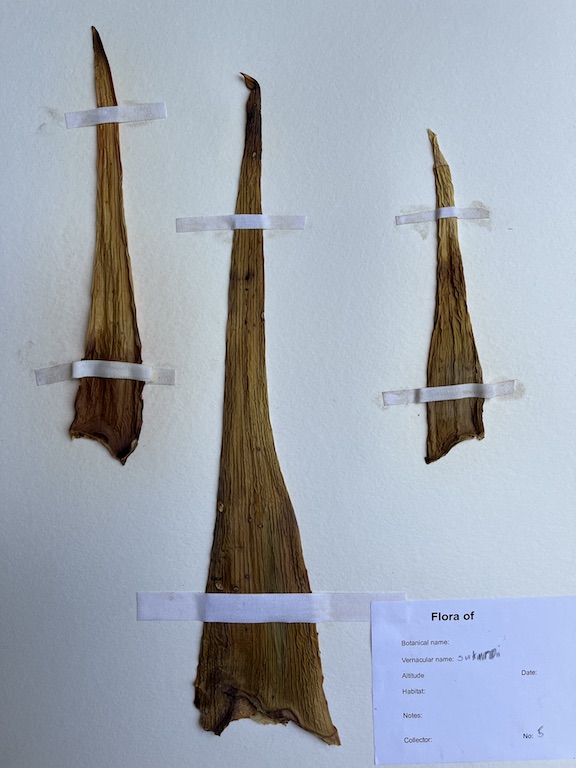
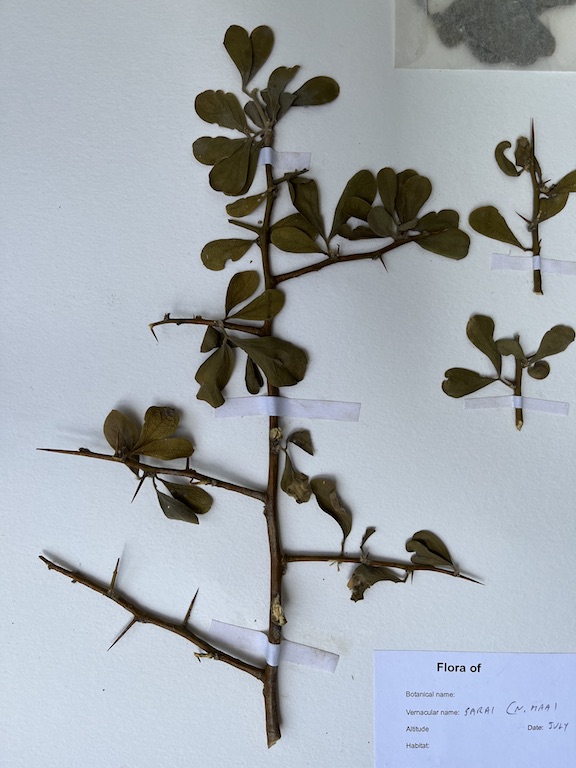
The botanicals used are
The artistry of the woman who prepared thelmala for milk is able to make the most of the flavor tonalities of each wood, or not, depending in her skill. I have fully documented the preparation of the lmala to provide the full context for the ethnobotany.
When milk was plentiful, women selected the botanicals she burned based on the keeping qualities the wood brought to the fermentation process. When milk was abundant, wood was selected that would preserve the milk the longest. Now, when there is rarely cow milk available, women are selecting primary for taste and aroma.
There are many woods to choose from, and so what woods a Samburu woman uses does depend on where she lives — Lowlands choices are different form Highland choices, and choices differ within these broad geographic areas depending on exact elevation and where one is in relationship to mountains, washes, and other features that might favor one plant over another.
Highly sought after woods that grow in the mountains are collected by large groups of women as there is security from wild buffalo and elephants when moving in a group.



 Samburu Research