Noun Pronunciation: XXX The whole process of rinsing the calabash after use: first heating with burning sticks, then pouring out the embers, and finally cleaning the interior by removing the sides of ash to the desired point.
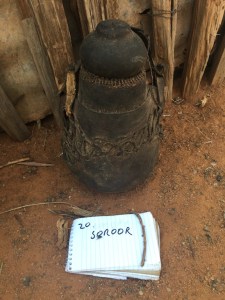
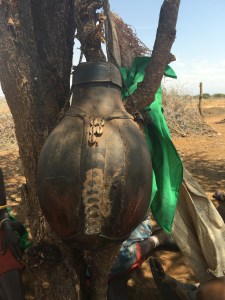
Noun Pronunciation: XXX A lmala to carry blood or camel milk, hung from the camel’s neck while traveling. It is oval with an oval lid. It is used in the manyatta when the camels are home.
Description
Container capacity: XXX
Cylindrical wooden container with conforming wooden lid. The vessel’s sides swell outward below its neck to a rounded base. Its exterior of container is painted black and decorated with carving. Decorative leather stitching encircles the vessel’s top [Is there also a leather collar? Leave remarks in Comments below]. Leather carrying straps of varying widths encircle its sides at the waist and support the base. The detached carved wooden lid is roughly urn-shaped, with sides that slope from a flat top to a low bulbous waist and slide over the vessel’s neck. Lid is painted black but otherwise undecorated. [Is this description correct? Leave remarks in Comments.]
Noun Alt.: seenderi elpayan Pronunciation: XXX Medium- to large-sized wooden lmala that is used to store milk for the elpayan (husband, or man of the household), who receives the seenderi from his wife’s mother when he is married. He then uses the seenderi for the rest of his life.
The seenderi (with green lid) on the left has a skin bottom, while the nkerai (with orange lid) on the right is carved of wood.
The seenderi is carved of wood. It has a lid that also serves as a cup, and its bottom is covered with skin. It shares these characteristics with the lmala nkodoos. The seenderi‘s exterior may be decorated with red ochre or painted black (animal blood mixed with ash). The cap [Made of beads and wire, or merely decorated with beads? Comment below], which also functions as a cup, is painted with ochre and decorated with beads.
Typically, when a man comes home, he looks for the seenderi, and thus does not have to ask for food. It is always kept full by his wife. As is the general consumption practice (except, of course, amongst children), a little milk is always left in the bottom, which can then be used by anyone after pouring into their appropriately designated lmala. [This seems to contradict the preceding sentence that the seenderi is “always left full.” Comments?]
A murran (warrior) will never drink from this lmala.
Description
Container capacity: XXX
Cylindrical wooden vessel with a leather base and a cylindrical cup-shaped lid. The vessel’s straight sides swell outward gently below its rim to a slightly swollen, rounded base with a flat bottom. The vessel’s exterior is often painted black using animal blood mixed with ash. Leather carrying straps of varying widths encircle its sides at the waist and support the base. The detachable lid can be made of leather or a plastic cup. The lid also can be painted black or ochre-stained, but is usually otherwise undecorated.
Noun Pronunciation: XXX Lmala for butter making, filled with cream fermented to the ngorno stage.
The nyatio is made from a large, round gourd rather than the more common carved wood most lmalasin are made from. It is cleaned with water or, preferably, cow’s urine rather than the burning botanicals used with other lmalasin. The urine is thought to help the milk separate. The nyatio is filled between one-half and two-thirds full. The two handles on either side, one longer than the other, facilitate hanging and shaking the container to churn butter. (Can you use camel milk? Leave your answer in the Comments below.]
Hung from the center beam of the ngaji [Is this the mother’s hut? Leave remarks in Comments below], the nyatio is shaken to produce ngorno (butter).
Nyatio are made from a huge gourd purchased from the Massai, the gourd’s circumference being that of the circle defined by the arms of a big man. Rather than capped with a skin lid, the nyatio is topped by a wooden stopper, not hollow, which has been made from a light wood, such as loishimi.
Draft: used for churning butter, made of loishimi, gourd; the wooden stopper is made of loishimi and is not hollow (query fact check the stopper).
Noun Pronunciation: XXX Calabash for milk, meat, or butter.
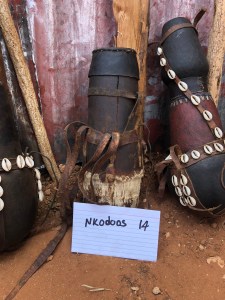
Nkodoos milk container; note the animal hair on the skin bottom.
The lmala nkodoos is carved out of lokudong’itand no other wood. It has a skin lid that also serves as a cup, and a skin bottom; it shares the latter feature with the seenderi. It is used as a collecting container, both for milking and for bleeding a cow. (Cow blood was mixed with milk in January and February to supplement the diet of children after the long rain ended, and to feed boys whose penis was recovering from being cut in the circumcision ceremony; see kule saroi.)
Description
Capacity: XXX liters
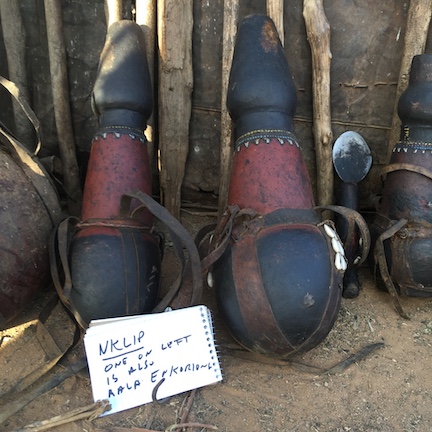
Nkodoos, flanked by larger lmalasin in the nklip class.
Cylindrical wooden vessel with a leather base and a cylindrical cup-shaped leather lid. The container’s neck is long, straight and pillar-like, and swell gently in circumference to a slightly wider leather base. The ratio between the base and the neck is roughly 1:1.2. The leather base secured in place with stitching. The container’s exterior is typically painted black (using ash mixed with animal blood). Leather carrying straps of varying widths encircle the vessel’s sides at its waist. The detachable lid is cup-shaped and made of leather. The lid’s flat leather top is nailed to the sides. The lid is also usually painted black.
Pair of lmala nklip.Round base on nklip.Long lid that serves as cup.
Pronunciation: luh-mall-uh uhn-glip Wooden container for milk that can be used by anyone, normally for milking.
Milk containers in the nklip class have:
A body carved from wood
A round bottom
A long neck
Usually a long lid, also carved from wood
Leather carrying straps
Some nklip are decorated with skirai (cowry shells) as a matter of personal preference. Skirai are purchased at the local market. The use of color is also a choice. Black is created by mixing ash with animal blood. Red is from lkaria (ochre).
Nklip, with human legs for scale.
An nklip has a leather collar stitched to the top of the wooden body to secure the lid; the lid’s rim slides inside the collar when stored in place on the body. The stitching at the collar is often decorative as well as functional, and this is also a matter of personal preference.
Lids also serve as cups. They are hollow and often carved of wood in an upside-down urn shape. The njongor is an exception; it has a woven lid.
Most households have many nklip for milking, although with the decline in the quantity and quality of herds, households have downsized their collections of milking containers.
Description
Capacity: XXX liters
A medium to small container with a lid, used for milking, storing, and drinking milk. The cylindrical hollow body is carved from wood and has long, straight sides that swell outward gently below its neck to a swollen, rounded base. The vessel’s exterior is often painted black or stained red with ochre, and has decorative stitching at the top to secure a leather collar that holds the lid. Leather carrying straps of varying widths encircle the body. Ornamentation may include cowry shells, ochre, and a black paint made of ashes mixed with blood. The separate lid is often roughly urn-shaped, with sides that slope outward below a flat top to a low, rounded waist, then taper sharply at the bottom to fit inside the body’s leather collar. The lid can also be painted black or stained with ochre.
Noun Pronunciation: XXX Wooden lmala with a woven lid, used to hold milk for blessings conducted by either women or men.
The blessing milk is mixed with water. The diluted milk can be poured into the cap and then poured onto the ground.For example, when dedicating a building, the milk will be poured around the foundation perimeter. With somewhat more ritual, the blessing milk can also be poured onto a cow tail, or the tail can be dipped into the milk and then shaken onto the ground while rhythmically chanting ngai (God). The blessing might be conducted sitting or moving. Women walking into the mountains to pray under a sacred tree will dip leaves into milk and chant the blessing while walking to bless each tree found growing around pooled water in otherwise dry river beds.
The njongor is also the girl’s lmala, although the distinction between this and the traditional boy’s lmala el laiyok is weakening. Each child has her own njongor.
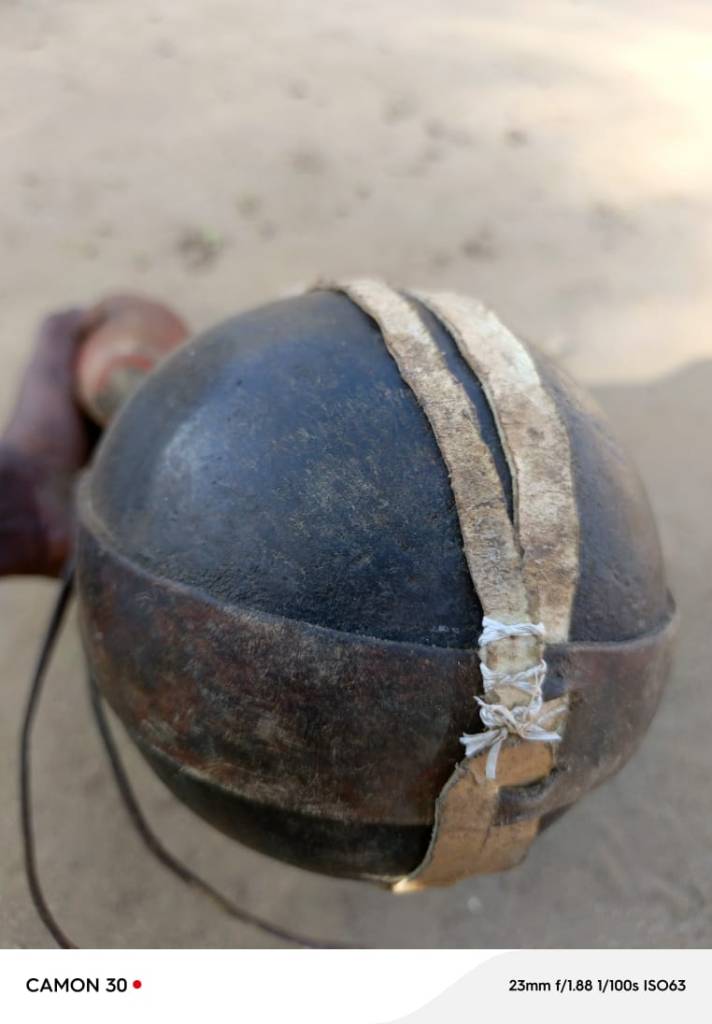
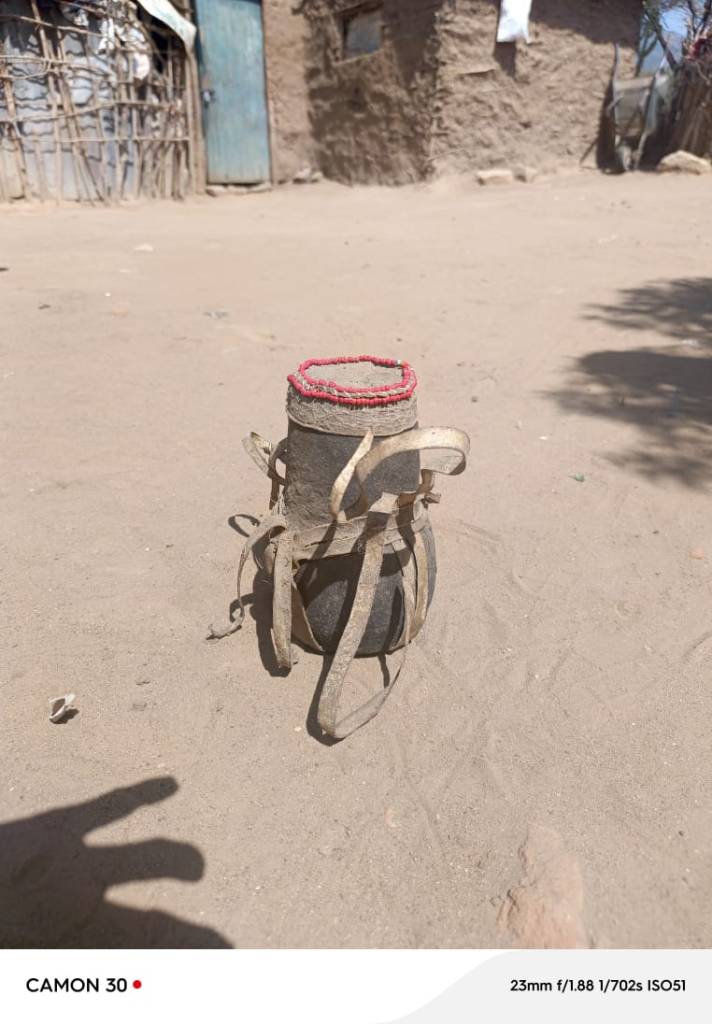
The njongor‘s lid is not carved from wood, as with other containers in the nklip group. Instead, it is woven of grass (the tan-colored bands in the photo above) and plastic sacks (the red bands in the photo).
The njongor is now rare in the Samburu Highlands and in communities near roads.
Description
Capacity: XXX liters
Cylindrical wooden vessel with a separate woven lid. The vessel’s long, straight sides swell outward gently below its neck to a swollen, rounded base. The vessel’s exterior is stained red with ochre or painted black (made from ash mixed with blood), and it has decorative leather stitching in white and green at its neck that support a collar. Leather carrying straps of varying widths encircle its sides. The straps are often decorated with skirai (cowry shells). The detachable lid is roughly urn-shaped and woven of grass ( Its sides slope outward from a flat top to a leather collar that slides over the vessel’s neck.
Noun Pronunciation: XXX Gourd lmala with a hollow cup-shaped wooden lid, of varying sizes and shapes. The nkirau belongs to women, children, and elders, but is never used by murran (warriors).
The dried gourd is purchased from the Maasai. The Maasai use this gourd for milking, but the Samburu use it for milk storage and mixing. As gourds are fragile compared with wood, the nkirau is not filled around cows because it could easily be destroyed with a kick.
The nkirau shares a style of flat-topped carved wooden cup with the lmala lkantir. With the nkirau, the angle at which the cap is expanded to its largest bulbous diameter is less sharp than in the lkantir; in other words, the walls of the cap as it descends from its flat top, while more angled, are more parallel than those of the lkantir, whose shape to my eye is one of remarkable elegance. The lid is often decorated with colorful stitching close to the rim.
A Turkana form of nkirau. Samburu people will use this form of container, but they do not make it — and they would never drink Turkana-processed milk from it.
Few examples of nkirau remain, as it has been so long since enough cows existed to produce enough milk to fill one. With the apparent definitive collapse of Samburu herds as I write this in the summer of 2022, the shape likely will never be used again. The same is true of the lmala nyatio, which has the circumference of the arms of a big man; my Samburu friends estimate it has not been used since the drought of 1986.
The nkirau is very similar to the lmalanaililioriexcept it has only a single side band running up the base to the waist belt.
Description
Container capacity: XXX
Cylindrical gourd container with urn-shaped wooden lid. The vessel’s sides swell outward below its neck to bulbous shoulders, then taper inward to a swollen rounded base. The container’s exterior is stained with ochre and has decorative leather stitching encircling its top. Leather carrying straps of varying widths encircle its sides at the waist and support the base. The detachable carved wooden lid is roughly urn-shaped, with sides that slope to a rounded waist, then taper sharply to fit over the gourd’s neck. The lid is usually painted black using animal blood mixed with ash, but is otherwise undecorated.
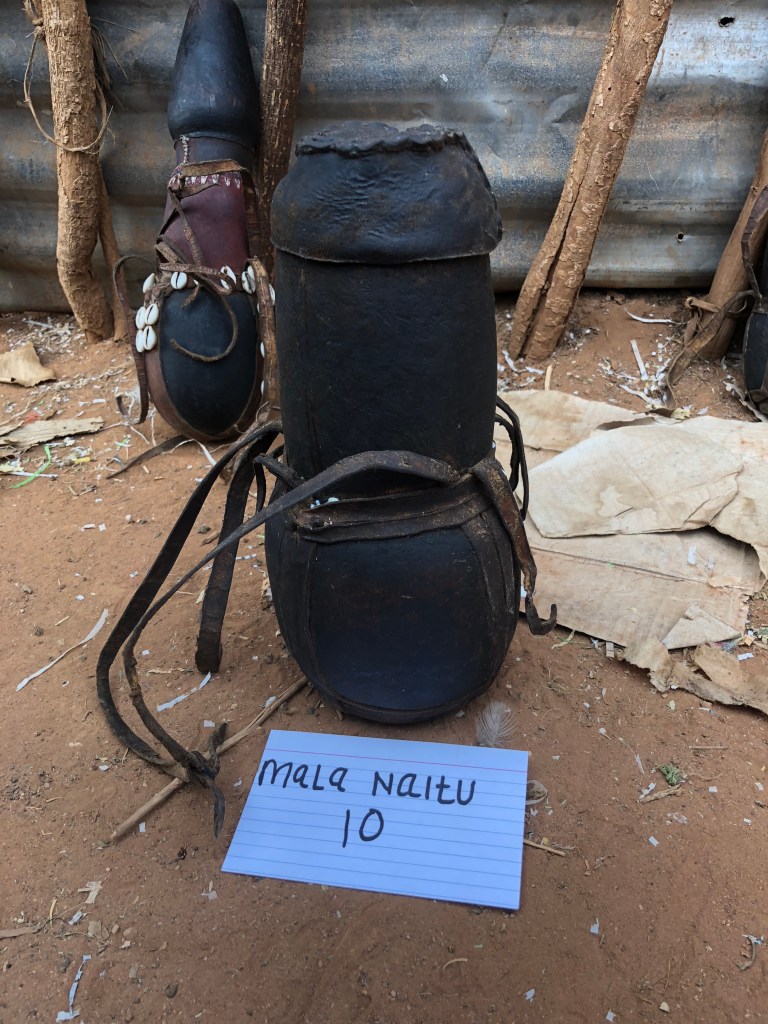
Noun Pronunciation: ehn-eye’-too Small- or medium-sized multi-purpose lmala used for milking, drinking, holding blood harvested from the cow, by women and by children.
What makes a naitu different from an nklip, but related? The naitu is made of wood, has a bulbous base and straight neck like nkelip, though the base may less bulbous and may be flat bottomed. As the plastic, woven, or leather lid fits directly over the neck, there is no stichking or leather collar. Ocre and cowery shells are associated with some naitu, but not with all naitu.
The naitu has a leather or woven cup. The body’s neck is narrower than those lmala in the nklip group, and the ratio of neck to bulb-shaped base is reduced. When the container’s shape is the same but its cup is plastic, then the lmala is known as an nkerai.
Women use this type of lmala for their entire lives. Children begin to use the naitu when their appetite grows, usually at about the age of six. The naitu is also used to fetch the circumcision water on the morning of that ceremony. Circumcision takes place when a new Age Set is declared. At that point, boys are initiated into the murran (warrior) stage of life and they shift to using the lmala loolmuran.
Three different types of naitu exist: 1) Naitu elpayan – a husband’s naitu made by his wife when they are first married. 2) Naitu nang’orchiereki – a smaller naitu for the measure of one collection of blood bled from a cow for mixing with milk to make kule njuloti and kule saroi. 3) Naitu elayiok – a boy’s lmala that he carries with him when the cattle move away from the manyatta.
Description
Capacity: XXX liters
Cylindrical wooden vessel with a detachable leather lid. The hollow body’s straight sides swell outward gently below its rim to a slightly swollen, rounded base with a flat bottom. The vessel’s exterior is painted black. Leather carrying straps of varying widths encircle its sides at the waist and support the base. Unlike some other lmalasin types, the naitu‘s body has no leather collar, so the lid rests on top of the container. The lid, which also serves as a cup, can be made of leather or woven of grass and plastic sacks. The lid is often painted black.





 Samburu Research