Noun Pronunciation: XXX Calabash for milk, meat, or butter.
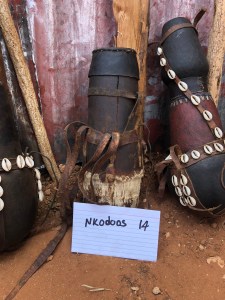
Nkodoos milk container; note the animal hair on the skin bottom.
The lmala nkodoos is carved out of lokudong’itand no other wood. It has a skin lid that also serves as a cup, and a skin bottom; it shares the latter feature with the seenderi. It is used as a collecting container, both for milking and for bleeding a cow. (Cow blood was mixed with milk in January and February to supplement the diet of children after the long rain ended, and to feed boys whose penis was recovering from being cut in the circumcision ceremony; see kule saroi.)
Description
Capacity: XXX liters
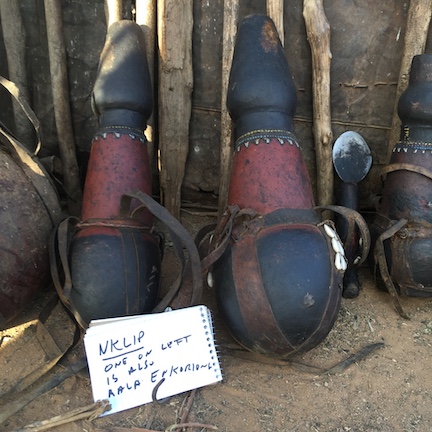
Nkodoos, flanked by larger lmalasin in the nklip class.
Cylindrical wooden vessel with a leather base and a cylindrical cup-shaped leather lid. The container’s neck is long, straight and pillar-like, and swell gently in circumference to a slightly wider leather base. The ratio between the base and the neck is roughly 1:1.2. The leather base secured in place with stitching. The container’s exterior is typically painted black (using ash mixed with animal blood). Leather carrying straps of varying widths encircle the vessel’s sides at its waist. The detachable lid is cup-shaped and made of leather. The lid’s flat leather top is nailed to the sides. The lid is also usually painted black.
Pair of lmala nklip.Round base on nklip.Long lid that serves as cup.
Pronunciation: luh-mall-uh uhn-glip Wooden container for milk that can be used by anyone, normally for milking.
Milk containers in the nklip class have:
A body carved from wood
A round bottom
A long neck
Usually a long lid, also carved from wood
Leather carrying straps
Some nklip are decorated with skirai (cowry shells) as a matter of personal preference. Skirai are purchased at the local market. The use of color is also a choice. Black is created by mixing ash with animal blood. Red is from lkaria (ochre).
Nklip, with human legs for scale.
An nklip has a leather collar stitched to the top of the wooden body to secure the lid; the lid’s rim slides inside the collar when stored in place on the body. The stitching at the collar is often decorative as well as functional, and this is also a matter of personal preference.
Lids also serve as cups. They are hollow and often carved of wood in an upside-down urn shape. The njongor is an exception; it has a woven lid.
Most households have many nklip for milking, although with the decline in the quantity and quality of herds, households have downsized their collections of milking containers.
Description
Capacity: XXX liters
A medium to small container with a lid, used for milking, storing, and drinking milk. The cylindrical hollow body is carved from wood and has long, straight sides that swell outward gently below its neck to a swollen, rounded base. The vessel’s exterior is often painted black or stained red with ochre, and has decorative stitching at the top to secure a leather collar that holds the lid. Leather carrying straps of varying widths encircle the body. Ornamentation may include cowry shells, ochre, and a black paint made of ashes mixed with blood. The separate lid is often roughly urn-shaped, with sides that slope outward below a flat top to a low, rounded waist, then taper sharply at the bottom to fit inside the body’s leather collar. The lid can also be painted black or stained with ochre.
Noun Pronunciation: XXX Wooden lmala with a woven lid, used to hold milk for blessings conducted by either women or men.
The blessing milk is mixed with water. The diluted milk can be poured into the cap and then poured onto the ground.For example, when dedicating a building, the milk will be poured around the foundation perimeter. With somewhat more ritual, the blessing milk can also be poured onto a cow tail, or the tail can be dipped into the milk and then shaken onto the ground while rhythmically chanting ngai (God). The blessing might be conducted sitting or moving. Women walking into the mountains to pray under a sacred tree will dip leaves into milk and chant the blessing while walking to bless each tree found growing around pooled water in otherwise dry river beds.
The njongor is also the girl’s lmala, although the distinction between this and the traditional boy’s lmala el laiyok is weakening. Each child has her own njongor.
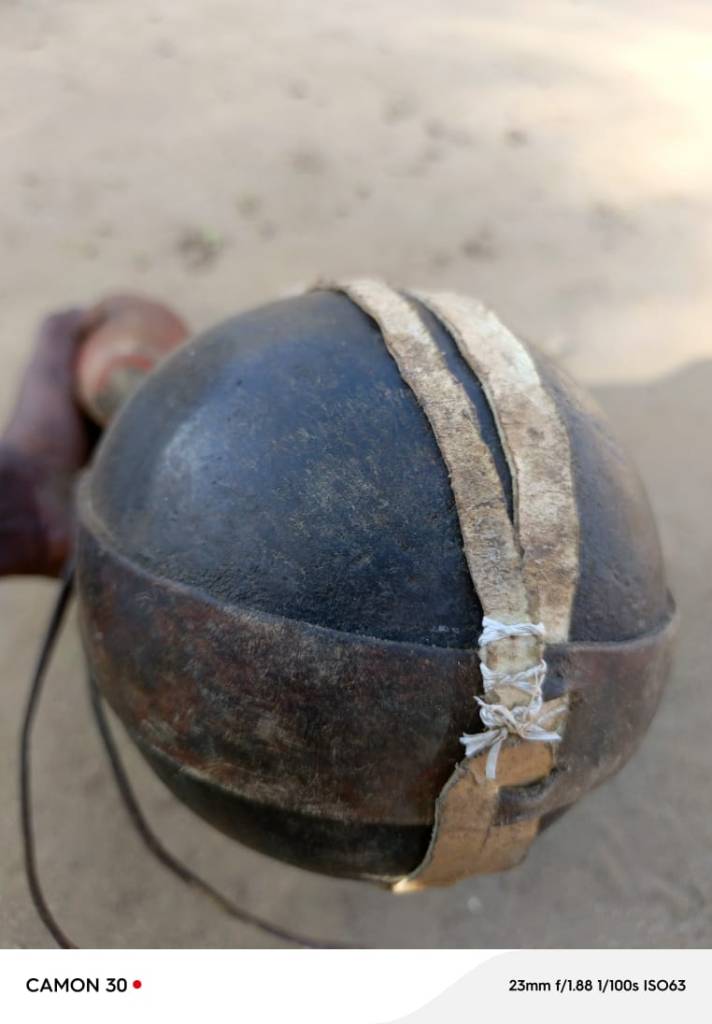
The njongor‘s lid is not carved from wood, as with other containers in the nklip group. Instead, it is woven of grass (the tan-colored bands in the photo above) and plastic sacks (the red bands in the photo).
The njongor is now rare in the Samburu Highlands and in communities near roads.
Description
Capacity: XXX liters
Cylindrical wooden vessel with a separate woven lid. The vessel’s long, straight sides swell outward gently below its neck to a swollen, rounded base. The vessel’s exterior is stained red with ochre or painted black (made from ash mixed with blood), and it has decorative leather stitching in white and green at its neck that support a collar. Leather carrying straps of varying widths encircle its sides. The straps are often decorated with skirai (cowry shells). The detachable lid is roughly urn-shaped and woven of grass ( Its sides slope outward from a flat top to a leather collar that slides over the vessel’s neck.
Noun Pronunciation: XXX Gourd lmala with a hollow cup-shaped wooden lid, of varying sizes and shapes. The nkirau belongs to women, children, and elders, but is never used by murran (warriors).
The dried gourd is purchased from the Maasai. The Maasai use this gourd for milking, but the Samburu use it for milk storage and mixing. As gourds are fragile compared with wood, the nkirau is not filled around cows because it could easily be destroyed with a kick.
The nkirau shares a style of flat-topped carved wooden cup with the lmala lkantir. With the nkirau, the angle at which the cap is expanded to its largest bulbous diameter is less sharp than in the lkantir; in other words, the walls of the cap as it descends from its flat top, while more angled, are more parallel than those of the lkantir, whose shape to my eye is one of remarkable elegance. The lid is often decorated with colorful stitching close to the rim.
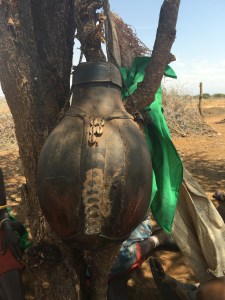
A Turkana form of nkirau. Samburu people will use this form of container, but they do not make it — and they would never drink Turkana-processed milk from it.
Few examples of nkirau remain, as it has been so long since enough cows existed to produce enough milk to fill one. With the apparent definitive collapse of Samburu herds as I write this in the summer of 2022, the shape likely will never be used again. The same is true of the lmala nyatio, which has the circumference of the arms of a big man; my Samburu friends estimate it has not been used since the drought of 1986.
The nkirau is very similar to the lmalanaililioriexcept it has only a single side band running up the base to the waist belt.
Description
Container capacity: XXX
Cylindrical gourd container with urn-shaped wooden lid. The vessel’s sides swell outward below its neck to bulbous shoulders, then taper inward to a swollen rounded base. The container’s exterior is stained with ochre and has decorative leather stitching encircling its top. Leather carrying straps of varying widths encircle its sides at the waist and support the base. The detachable carved wooden lid is roughly urn-shaped, with sides that slope to a rounded waist, then taper sharply to fit over the gourd’s neck. The lid is usually painted black using animal blood mixed with ash, but is otherwise undecorated.
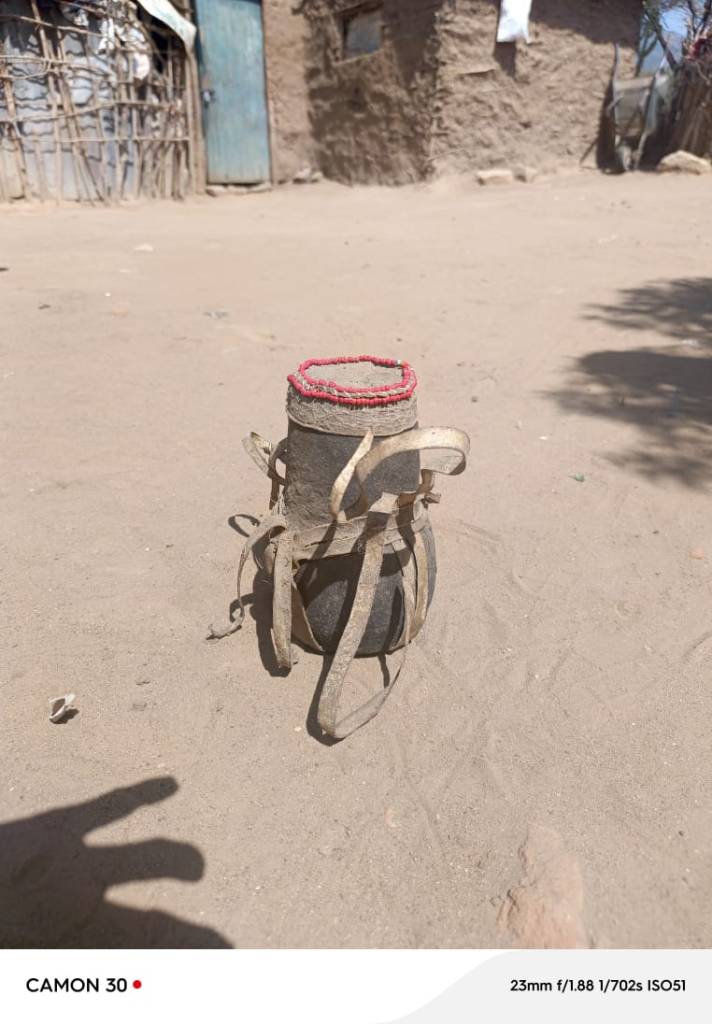
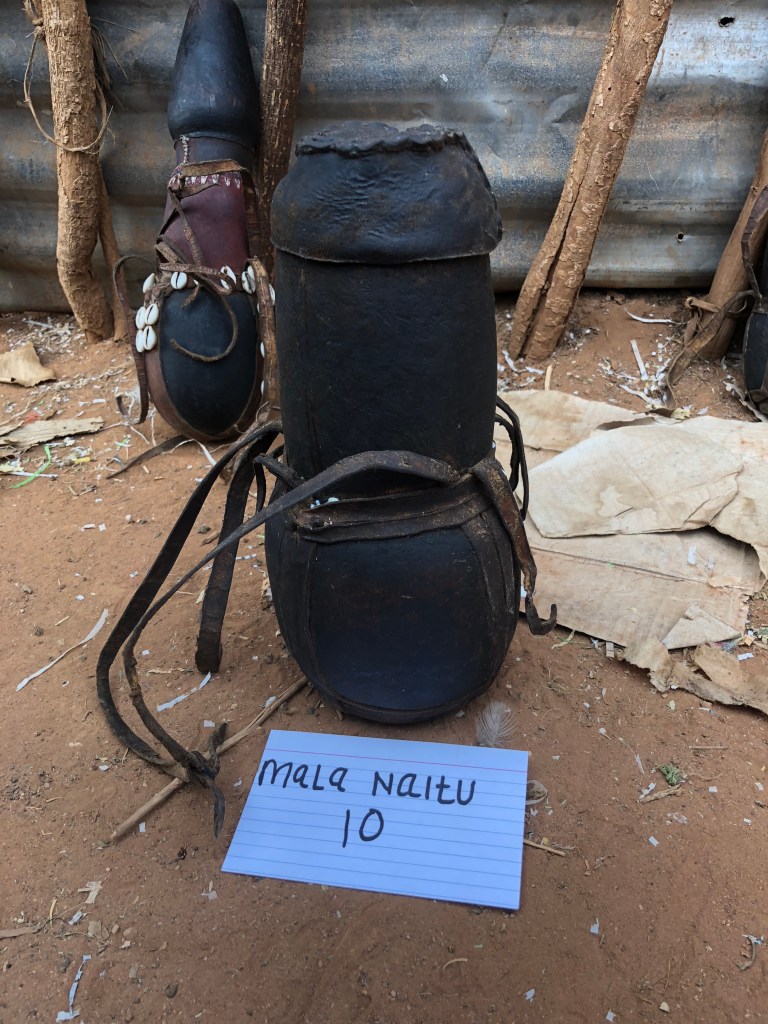
Noun Pronunciation: ehn-eye’-too Small- or medium-sized multi-purpose lmala used for milking, drinking, holding blood harvested from the cow, by women and by children.
What makes a naitu different from an nklip, but related? The naitu is made of wood, has a bulbous base and straight neck like nkelip, though the base may less bulbous and may be flat bottomed. As the plastic, woven, or leather lid fits directly over the neck, there is no stichking or leather collar. Ocre and cowery shells are associated with some naitu, but not with all naitu.
The naitu has a leather or woven cup. The body’s neck is narrower than those lmala in the nklip group, and the ratio of neck to bulb-shaped base is reduced. When the container’s shape is the same but its cup is plastic, then the lmala is known as an nkerai.
Women use this type of lmala for their entire lives. Children begin to use the naitu when their appetite grows, usually at about the age of six. The naitu is also used to fetch the circumcision water on the morning of that ceremony. Circumcision takes place when a new Age Set is declared. At that point, boys are initiated into the murran (warrior) stage of life and they shift to using the lmala loolmuran.
Three different types of naitu exist: 1) Naitu elpayan – a husband’s naitu made by his wife when they are first married. 2) Naitu nang’orchiereki – a smaller naitu for the measure of one collection of blood bled from a cow for mixing with milk to make kule njuloti and kule saroi. 3) Naitu elayiok – a boy’s lmala that he carries with him when the cattle move away from the manyatta.
Description
Capacity: XXX liters
Cylindrical wooden vessel with a detachable leather lid. The hollow body’s straight sides swell outward gently below its rim to a slightly swollen, rounded base with a flat bottom. The vessel’s exterior is painted black. Leather carrying straps of varying widths encircle its sides at the waist and support the base. Unlike some other lmalasin types, the naitu‘s body has no leather collar, so the lid rests on top of the container. The lid, which also serves as a cup, can be made of leather or woven of grass and plastic sacks. The lid is often painted black.
Noun Pronunciation: XXX Heavy lmala that is large and can hold a lot of milk. Its purpose is to collect milk. This is the only lmala that can be used by anyone — children, grownups, men, women, elders, and guests. [This is the same basic definition as the nklip. Is this correct? Leave your remarks in Comments below.]
The nairoshi has no social distinction, so it is interesting to note that its basic shape and coloration come from outside the Samburu culture. Its core is painted over in patterns usually associated with the Turkana. The lid or cap is distinctively Turkana. Ochre is painted around the top of the cup, the flared hat part, and then four wide vertical bands down to the slightly outwardly curved base, leaving four black rectangles. A similar pattern is repeated below, with the black rectangles being more square than rectilinear. What makes the nairoshi decoration Samburu is the use of skirai (cowry shells) on the leather straps.
Description
Capacity: 1 to 1 1/2 liters
Cylindrical storage vessel with a leather cap. Colored stitching ending in downward-pointing triangles holds the inner leather lip in place. The line from the base to the top of the lmala is almost straight, though there is a slight outward curve at the bottom, just before the cap is reduced to fit within the mouth of the main container. The main part of the cap is a cylinder, wider at the base than the top. What makes the cap distinctively Turkana is that before the main portion of the cup narrows it again angles out forming a hat with a flared rim. The main part of the cap is a cylinder that is wider at the base than at the top, with a slight outward curve at the bottom, just before the cap is reduced to fit within the mouth of the vessel.
Noun Pronunciation: XXX Ceremonial name used for a medium- to large-sized lmala nklip when it is carried by the best man in a wedding procession. It is usually used to store sheep fat.
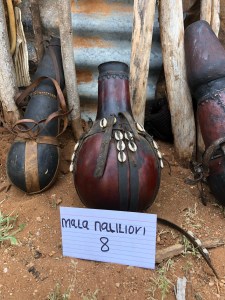
The naililiori its carried by the best man at a wedding, with one strap wrapped around his wrist and his fingers over the lid. On the second day of the wedding ceremony, the husband, best man, and bride (in this order) walk out of the bride’s manyatta through her father’s gate. They step over a band of grass her father has strewn across the doorway to mark the transition. Traditionally, the procession moves with slow, stately steps until they reach the husband’s manyatta. (See lmala enkoriong for a description of how lmalasin are used in a wedding ceremony.) After the wedding, the lmala naililiori is once again used as an nklip.
Made from a gourd, the naililiori has colored bands ending in small triangles woven in at its neck. This holds in place a leather lip that fits the conical cup. The lmala nkirau is identical to the naililiori except it has only a single side band running up from the base to the waist belt.
Description
Capacity: XXX liters
Cylindrical vessel made from a gourd, with a conical cup-shaped leather lid. The vessel’s long, straight sides swell outward gently below its neck to a swollen, rounded base. The vessel’s exterior is often stained red with ochre and decorated with skirai (cowry shells). Decorative leather stitching at its neck secures a leather collar. The removable leather cup is slightly wider and bulbous at its base, and flat on the top.
A wide vertical leather strap runs up the from the center bottom of the vessel and is held in place by two wide leather straps along the waist. It is not uncommon for the straps to retain some animal hair or to be decorated with cowry shells. The detached lid is roughly cup-shaped, with sides that slope outward below a rounded top to a low, rounded waist, then taper sharply at the bottom to fit over the vessel’s neck. The lid also can be painted black or ochre-stained, but is otherwise undecorated.
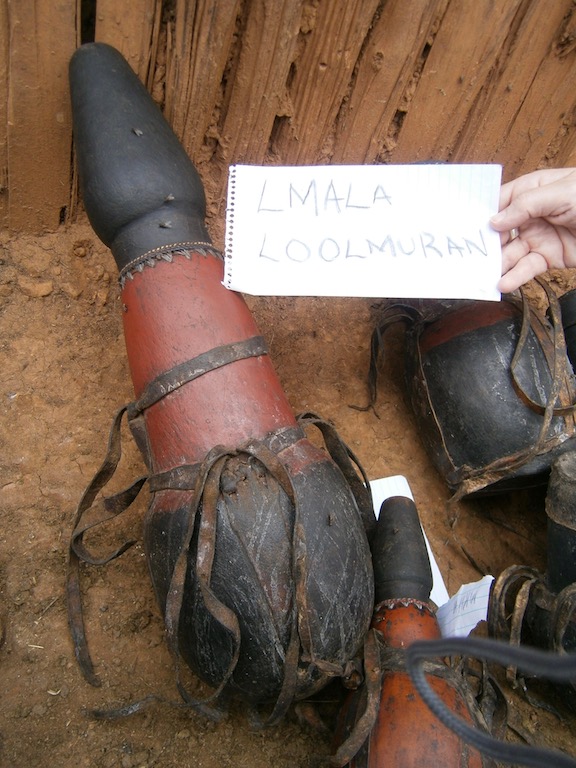
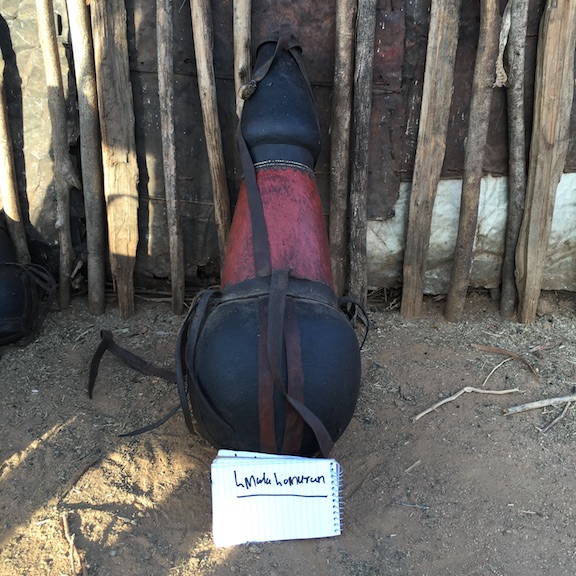
Noun Pronunciation: XXX The only lmala the murran (warriors) drink from. A very large wooden lmala with a hollow cup that also acts as a lid.
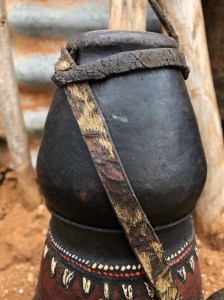
The loolmuran is an nklip and has that group’s basic shape — a bulbous base, and a straight section that is at least as long as the bulbous portion and usually a little longer. The stitching pattern holding the leather in place at the neck into which the wooden lid is tightly fitted is the same as for the nklip and other lmalasin, except in this unique case, the color of the bottom triangular-shaped stitching is green. In Samburu culture, green is associated with boys, unlike in many Eurocentric cultures, where blue is associated with boys and pink with girls.
Because the loolmuran is so large, it is made of a lighter wood, such as bolorio. As with the lmala seenderi, the wood on the loolmuran‘s lid and its straight neck section are often colored red with ochre. The color and pattern are not prescribed. The neck and cup can be read as a phallic shape; the lid, which fits into a leather sleeve, is shaped like the tip of an erect penis. A lmala loolmuran is larger than a typical nklip. Its leather carrying straps are never decorated, so it projects a sense of raw strength and power.
When milk was plentiful before the beginning of the modern drought cycles in 1972, a loolmuran’s capacity could be as large as 10 liters. Today, the average size is about 5 liters, but it can also be smaller, because it is defined by its shape and decorations and not its size. Since it is so large, the loolmuran is made of a lighter wood, such as bolorio.
Before being circumcised, boys wear a sainanyori (single-strand necklace of small, green glass beads). One finds a sainanyori around the necks of babies at about six months, just as in Mexican culture, for example, girl babies get their ears pierced. One knows a Samburu infant is a boy in the same way one knows a Mexican infant is a girl — by their jewelry. After the initiate boy has been circumcised and is led back into his mother’s hut for his penis to heal, the first thing that happens is that the sainanyori is removed from his neck and slipped over the neck of the lmala loolmuran [Is there a loolmuran in every mother’s hut, or just in the warriors’ huts? Leave your remarks in Comments below]. It stays there for seven to 10 years. No ceremony exists for removing the sainanyori. At some point, the mother decides it is time to remove it, typically after the boy has grown a lot and is transitioning to the next stage in life, which is as an elder.[What happens to the sainanyori after the boy becomes an elder? Leave your remarks in Comments below]
Description
Capacity: 5 liters on average
Cylindrical wooden vessel with an urn-shaped wooden lid. The vessel’s long, straight sides swell outward gently below its neck to a bulbous rounded base ornamented with carved designs. The vessel’s exterior is painted black or stained red with ochre, and it has decorative leather stitching in white and green at its neck that support a leather collar. Leather carrying straps of varying widths encircle its sides at the waist and support the base. It is not uncommon for the straps to retain some animal hair. The separate carved wooden lid is roughly urn-shaped, with sides that slope outward below a rounded top to a low, rounded waist, then taper sharply at the bottom to fit over the vessel’s neck. The lid also can be painted black or ochre-stained, but is otherwise undecorated.
Noun Pronunciation: XXX Big, round, and squat-bottomed lmala with a bulbous base and a bulbous, flat-topped lid, used to store milk inside the hut. A smaller version of the lkantir is called nkantir e ruat kini.
An lkantir container is carved of wood and has stitching at the top to attach the leather flange for the lid. The container’s neck is drilled with small holes, which are then stitched with multiple woven bands of colorful thread. The stitching design typically has woven triangles that point downwards. As with all lmalasin, the lkantir has leather carrying straps that may still retain some animal hair, and may be decorated with skirai (cowry shells). The exterior of both container and lid are usually painted red (ochre) or black (ash mixed with animal blood).
This lmala stays inside the house. As it is not taken out of the house for milking into, it must be filled from another lmala. Its primary function is to store milk for the murran (warriors). They drink the milk while sitting in the men’s section of the nkang (the manyatta house). When warriors come into the manyatta, they check the lmala loomuran (the container that is dedicated to their use). If the loolmuran is empty, they will pour milk from the lkantir into it.
As herd sizes have collapsed, Samburu room plans are changing. In 2022, it was possible to enter an nkang and not find a communal male sleeping area or section for communal feeding. Today (2024), this system has collapsed. Not only don’t the Samburu have milk from their own animals, but they now fear the murran (warriors). As we were editing this entry with our translator, Longhiro Lekudere, in February, 2025, at one point he had to run to a safer spot because of stray bullets from a quarrel between murrans. One person was injured. It was too dangerous to walk home, so Longhiro stayed in lodging in the town.
The flat top of an lkantir lid.
Lkantir lid, with bulbous base of the container in the background.
Is this a nkantir e ruat kini (small version of an lkantir)?
Description
Capacity: XXX liters
Cylindrical wooden container with urn-shaped wooden lid. The vessel’s sides swell outward below its neck to bulbous shoulders, then taper to a rounded base. Part of the exterior is often stained with ochre. Decorative leather stitching at the top of the container is used to secure a projecting leather collar that serves as a flange to support the lid. Leather carrying straps of varying widths encircle the container’s sides at the waist and support the base. The straps may retain some animal hair. The detached carved wooden lid is roughly urn-shaped, with sides that slope outward below a projecting top to a swollen rounded base, and then taper sharply inward again to fit inside the container’s leather flange. The lid is typically undecorated except for black or red paint — blood mixed with ash for the former, and ochre for the latter.








 Samburu Research