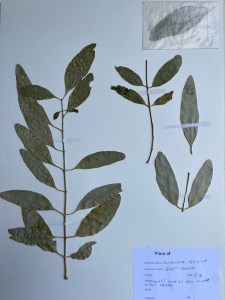
Botanicals for Lmala Preparation

Before its first use, the interior of a lmala (milk container) is prepared with a burning stick taken from a tree or shrub to impart a specific flavor to the milk stored within. The Samburu have a general word encompassing the botanicals used in this way: lorien. Tradition dictates that containers should be sterilized with botanicals after each use. The wood of some botanicals is also used to make the lmalasin.

For more information on the sterilization process itself, see the Introduction, and watch a short video filmed by my daughter at a Samburu manyatta.

Explore Botanicals Used to Sterilize or to Make Lmalasin

Each link below will take you to photos and descriptions of the common botanicals used in the context of the Samburu milk culture, either as a wood burned as part of the process of preparing the lmalasin interior for milking, or as woods use to make the lmalasin containers themselves.  


More

Use the following links to explore additional content collected through the Samburu Milk Project.

Introduction to the Samburu Milk Project
Dictionary Methodology and Acknowledgements
Stages of Milk Fermentation
Milk Taste and Texture Terms
Types of Milk Containers (Lmalasin)
The Culture of Milk — Idioms and Expressions
Other Samburu Words
Milk, Music and Religionscheduled completion in late 2025
Milking Songsscheduled completion in late 2025

This is the draft manuscript of the Samburu Milk Project, © 2024 William Rubel. 

musuti (21)

Noun
Pronunciation: XXX
A rag for the final stage of calabash preparation. 

A musuti is traditionally made from the twisted fibers of the inner bark of a tree — seepei in the Highlands or lchurai in the Lowlands. 

Some women weave a musuti by unraveling the white plastic threads of grain sacks. Using this style of musuti speeds up the final cleaning process but cannot produce the finest, most subtle milk flavors. In fact, nkalani (dirty) women tend to use the plastic scrubber as a shortcut. And yes, one can taste the difference.


Return to Types of Milk Containers.

This is the draft manuscript of the Samburu Milk Project, © 2024 William Rubel.
lpirra

Noun
Pronunciation: XXX
Plastic cup; plastic container for milk.

Used as the milk container for selling in villages and markets where non-Samburu will be buying. Also used to carry milk to market, or on other journeys. Lpirra are not classed as lmalasin, the general term for the wooden or gourd milking containers used by the Samburu.

Plastic containers are easy to clean, and importantly, if one is collecting milk for sale to an ethnically mixed clientele in a village or town market, then using plastic makes the milk more salable to non-pastoralists because it is not fermented or in any way flavored by the lmala cleaning process with burning sticks.Thus, milk for the market is more salable if it’s been milked into a plastic cup and then poured into a plastic bottle for sale. Old water bottles are the most common plastic containers for this purpose. 

Return to Types of Milk Containers.

This is the draft manuscript of the Samburu Milk Project, © 2024 William Rubel.

sosian

[No image. If you can take an image of a sosian, please contact me. Thank you.]

Noun
Pronunciation: XXX

A long stick made from the rib of the ltungai palm leaf. Its sharp edges are used to scrape loose layers off the inside of a long gourd calabash, especially an old one or one that hasn’t been used for sometime.

[Does  this the same purpose as a loriesi’e, or is it specifically designed to be used on gourds only? Leave remarks in Comments below.]

See also loriesi’e.

Return to Types of Milk Containers.

This is the draft manuscript of the Samburu Milk Project, © 2024 William Rubel.

loriesi’e (20)

Samburu loriesia, Wamba, Kenya

Noun
Alt.: loriesia
Pronunciation: XXX
Tool used to restore the interior of a lmala that hasn’t been used for a long time.

The tool is made of a wooden handle fitted on one end with a spoon-shaped metal blade. [Is the tool used to scrape the interior of the calabash before it’s smoked? Is this because the calabash isn’t rinsed with water and needs to have some of its interior removed? Does the tool actually remove some of the interior surface? Leave your remarks in Comments below].

See also sosian.

Description

Length: XXX
Handle diameter: XXX

Long-handled scraper with a wooden handle and a spoon-shaped metal blade fitted into one end. [Is the metal blade actually made from a spoon? Leave remarks in Comments.]

Return to Types of Milk Containers.

This is the draft manuscript of the Samburu Milk Project, © 2024 William Rubel.

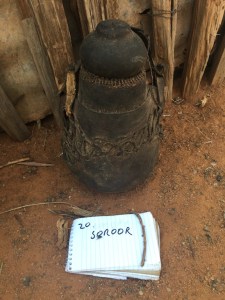
lmala soroor (19)

Samburu lmala soroor, Wamba, Kenya

Noun
Pronunciation: XXX
A lmala to carry blood or camel milk, hung from the camel’s neck while traveling. It is oval with an oval lid. It is used in the manyatta when the camels are home.

Description

Container capacity: XXX

Cylindrical wooden container with conforming wooden lid. The vessel’s sides swell outward below its neck to a rounded base. Its exterior of container is painted black and decorated with carving. Decorative leather stitching encircles the vessel’s top [Is there also a leather collar? Leave remarks in Comments below]. Leather carrying straps of varying widths encircle its sides at the waist and support the base. The detached carved wooden lid is roughly urn-shaped, with sides that slope from a flat top to a low bulbous waist and slide over the vessel’s neck. Lid is painted black but otherwise undecorated. [Is this description correct? Leave remarks in Comments.]

Return to Types of Milk Containers.

This is the draft manuscript of the Samburu Milk Project, © 2024 William Rubel.

lmala seenderi (18)

Noun
Alt.: seenderi elpayan
Pronunciation: XXX
Medium- to large-sized wooden lmala that is used to store milk for the elpayan (husband, or man of the household), who receives the seenderi from his wife’s mother when he is married. He then uses the seenderi for the rest of his life.

Seenderi, Samburu, Kenya
The seenderi (with green lid) on the left has a skin bottom, while the nkerai (with orange lid) on the right is carved of wood.

The seenderi is carved of wood. It has a lid that also serves as a cup, and its bottom is covered with skin. It shares these characteristics with the lmala nkodoos. The seenderi‘s exterior may be decorated with red ochre or painted black (animal blood mixed with ash). The cap [Made of beads and wire, or merely decorated with beads? Comment below], which also functions as a cup, is painted with ochre and decorated with beads.

Typically, when a man comes home, he looks for the seenderi, and thus does not have to ask for food. It is always kept full by his wife. As is the general consumption practice (except, of course, amongst children), a little milk is always left in the bottom, which can then be used by anyone after pouring into their appropriately designated lmala. [This seems to contradict the preceding sentence that the seenderi is “always left full.” Comments?]

A murran (warrior) will never drink from this lmala.

Description

Container capacity: XXX

Cylindrical wooden vessel with a leather base and a cylindrical cup-shaped lid. The vessel’s straight sides swell outward gently below its rim to a slightly swollen, rounded base with a flat bottom. The vessel’s exterior is often painted black using animal blood mixed with ash. Leather carrying straps of varying widths encircle its sides at the waist and support the base. The detachable lid can be made of leather or a plastic cup. The lid also can be painted black or ochre-stained, but is usually otherwise undecorated.


Return to Types of Milk Containers.

This is the draft manuscript of the Samburu Milk Project, © 2024 William Rubel.

lmala nyatio (17)

Noun
Pronunciation: XXX
Lmala for butter making, filled with cream fermented to the ngorno stage.

The nyatio is made from a large, round gourd rather than the more common carved wood most lmalasin are made from. It is cleaned with water or, preferably, cow’s urine rather than the burning botanicals used with other lmalasin. The urine is thought to help the milk separate. The nyatio is filled between one-half and two-thirds full. The two handles on either side, one longer than the other, facilitate hanging and shaking the container to churn butter. (Can you use camel milk? Leave your answer in the Comments below.] 

Hung from the center beam of the ngaji [Is this the mother’s hut? Leave remarks in Comments below], the nyatio is shaken to produce ngorno (butter).

Nyatio are made from a huge gourd purchased from the Massai, the gourd’s circumference being that of the circle defined by the arms of a big man. Rather than capped with a skin lid, the nyatio is topped by a wooden stopper, not hollow, which has been made from a light wood, such as loishimi.

Draft: used for churning butter, made of loishimi, gourd; the wooden stopper is made of loishimi and is not hollow (query fact check the stopper).  

Description

Container capacity: variable


Return to Types of Milk Containers.

This is the draft manuscript of the Samburu Milk Project, © 2024 William Rubel.