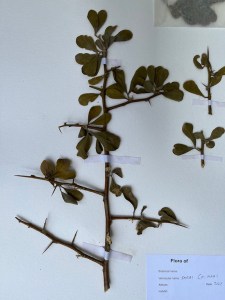
sukuroi (5)

Pronunciation: XXX
Botanical name: Aloe secundiflora (Alois Plant List) 

Sukuroi specimen, collected near Wamba, Kenya

Description: Pictured specimen collected near Lengusaka, Kenya.

Uses: “Good for chickens as a general tonic. Cut up one leaf in the morning and leave in the water until evening. Repeat the next day. Squeeze juice from leaf directly into chicken’s eye to cure eye problems. It stings so they go running off squeaking. Rub sap on cuts to promote healing. Soak for two days, the water becomes very bitter, and drink a cup. You will start to vomit a lot. Cures malaria. If you boil it, boil for one hour and strain. Goats and sheep may eat the plant, cows and camels do not, but it makes their milk bitter. The shepherds let them eat it as at least it is food.” — Robin Leparsante, Longhiro Lekudere in conversation with William Rubel [?]

“Malaria was the most frequently mentioned ailment that aloes were used to treat. … One of the most frequent uses, mentioned by informants from the Samburu and Masai ethnic groups, was the use of Aloe secundiflora for making traditional beer. The roots are dug up, stripped, soaked in honey and dried before being processed further for improving fermentation.” — Bjorå CS, Wabuyele E, Grace OM, Nordal I, Newton LE. The uses of Kenyan aloes: an analysis of implications for names, distribution and conservation. J Ethnobiol Ethnomed. 2015 Nov 25;11:82. doi: 10.1186/s13002-015-0060-0. PMID: 26607663; PMCID: PMC4658748. https://www.ncbi.nlm.nih.gov/pmc/articles/PMC4658748/ (accessed July 17, 2024).


Return to Botanicals for Lmala Preparation.

This is the draft manuscript of the Samburu Milk Project, © 2024 William Rubel.

smanderi (14)

Smanderi specimen collected near Wamba, Kenya

Pronunciation: XXX
Botanical name: XXX

Description: Pictured specimen collected in July, 2016, at 1,200 meters. Habitat: dry savannah.

Uses: My notes suggest this is used for making lmalasin (milk containers), usually translated into English as “calabash,” around the Ewaso Ng’iro river area. This includes Archers and the West Gate Conservancy near Lengusaka, Kenya.


Return to Botanicals for Lmala Preparation.

This is the draft manuscript of the Samburu Milk Project, © 2024 William Rubel.
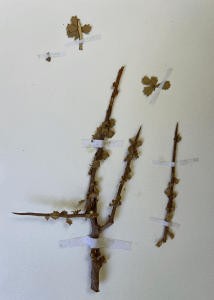
silapani

Silapani specimen, collected at Wamba, Kenya

Pronunciation: XXX
Botanical name: Cordia sinensis (Alois Plant List) [?]

Description: Pictured specimen collected near Lengusaka, Kenya. “A low leafy shrub or bush, multi-stemmed tree 3-12 m high and often with slender branches tending to droop. … Flowering occurs in December to February and August while fruiting in April to June and December. Fruit are eaten by monkeys, baboons and birds which are the main dispersal agents. … The species is common in dry riverine vegetation, usually with Salvadora persica, or in open bushland in low altitude arid and semi-arid areas on termite mounds and in littoral scrub.”

Uses: “The roots and bark are used for stomach disorders in both children and adults. A decoction of boiled roots is used to treat malaria but can cause an abortion. Bark and roots are mixed to treat conjunctivitis in cattle. Fodder: A very important source of fodder for goats, sheep, cattle and camels in dry areas. Food: The sweet and sticky tasty pulp of the fruit is eaten fresh and often put in porridge as a sugar substitute. The fruit pulp is sometimes used to make juice or brew local beer and sometimes mixed with tamarind (Tamarindus indica) juice and fermented. Gum: The clear gum from the tree is edible. Timber: The wood is used in the construction, furniture and for agricultural implements (such as tool handles, walking sticks, clubs, wooden spoons, stirrers and stools).”

Source: Orwa C, A Mutua, Kindt R , Jamnadass R, S Anthony. 2009 Agroforestree Database: a tree reference and selection guide version 4.0. http://www.worldagroforestry.org/sites/treedbs/treedatabases.asp (accessed 7/16/24).


Return to Botanicals for Lmala Preparation.

This is the draft manuscript of the Samburu Milk Project, © 2024 William Rubel.

serichoi (2)

Serichoi specimen, Wamba, Kenya

Pronunciation: XXX
Botanical name: Boscia coriacea; Capparaceae family

Description: Pictured specimen collected in June, 2016, near Lengusaka, Kenya, at 1,500 meters. Habitat: savannah. “An evergreen shrub common in all the drier parts of eastern Africa. Found in deciduous bushland and semidesert scrub. Common in most arid coastal lowlands of northern and eastern Kenya, mainly in Acacia-Commiphora bushland, often in rocky areas, loose red clay or sandy soils.”

Uses: “Firewood, furniture, material for temporary structures (branches, stems), utensils (wooden spoons), arrowheads, edible fruit (pulp sucked by humans, eaten by birds, seed must be boiled before eating), medicine (bark, roots), fodder (leaves), bee forage, shade, toothbrushes, cleaning (disinfecting) milk gourds (calabashes), veterinary medicine.”

Source: Useful Trees and Shrubs for Kenya, Ed. Patrick Maundu and Bo Tengnas; Nairobi, Kenya: World Agroforestry Centre, 2005; https://apps.worldagroforestry.org/downloads/Publications/PDFS/B13601.pdf (accessed July 2024).


Return to Botanicals for Lmala Preparation.

This is the draft manuscript of the Samburu Milk Project, © 2024 William Rubel.

seketi (1)

Seketi specimen from Wamba, Kenya

Pronunciation: seh-kee’-tee
Botanical name: Salvadora persica 

Description: Pictured specimen collected in June, 2016. Habitat: Under trees close to the dry Lengusake River, where it passes behind Lengusaka, Kenya. “An evergreen shrub or small tree to 6-7 m; main trunk erect or trailing with profusely branched, wide crown of crooked, straggling and drooping branches. … S. persica is widespread, notably in thorn shrubs, desert floodplains, river and stream bank vegetation, and grassy savannahs. Prefers areas where groundwater is readily available. … Also found in valleys, on dunes and on termite mounds.”

Uses: “[Fruits] can be eaten raw, cooked, or dried and stored. … The leaves are also cooked as a sauce and eaten with couscous or as a green vegetable. … Leaves and young shoots are browsed by all stock, but normally cattle do not occur in the driest part of the S. persica distribution range and hence it tends to be valued more as a camel, sheep and goat forage. Leaves make good fodder as their water content is high (15-36%). The high salt content of the leaves is said to affect the taste of milk, but the leaves are said to increase lactation in cows. … The wood is sometimes used for firewood and charcoal. However, it is not used for cooking meat, as it leaves a foul taste. Timber: The wood is soft, white, easy to work and is not liable to termite attack.”

Source: Orwa C, A Mutua, Kindt R , Jamnadass R, S Anthony. 2009 Agroforestree Database:a tree reference and selection guide version 4.0. http://www.worldagroforestry.org/sites/treedbs/treedatabases.asp (accessed 7/18/24)


Return to Botanicals for Lmala Preparation.

This is the draft manuscript of the Samburu Milk Project, © 2024 William Rubel.
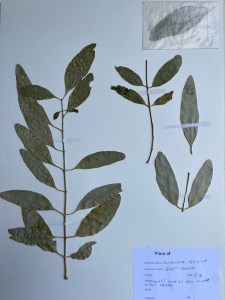
loisugi (10)

Pronunciation: XXX
Botanical name: Zanthoxylon chalybeum (from Alois Plant List)

Loisugi specimen collected in Kenya.

Description: Pictured specimen collected near Lengusaka, Kenya. Habitat: lowland. My notes suggest it grows in rocks at the viewpoint between Maralal and Wamba, and that its wood is used for preparing lmalasin. “A deciduous spiny shrub or tree up to 12 m, crown rounded but open. Bark pale grey; smooth dark with scales and prickles. The bole has characteristic large, conical, woody knobs with sharp prickles. The branches also bear scattered thorns with conspicuous dark scales. … Z. chalybeum is a tree of medium to low altitudes in dry woodland or grassland, often on termite mounds.”

Uses: Loisugi makes milk bitter when you repeatedly use it to cleanse a lmala over a long period of time. “Food: When dried, the leaves can be brewed to make a kind of tea. Fodder: The leaves and fruit are eaten by goats throughout the year. The branches are sometimes lopped for feed. Fuel: Z. chalybeum is a good firewood tree; it burns easily. Timber: Timber is very hard, heavy, elastic and highly durable. It works well, although it is difficult to nail; finishes and polishes well and has been used for carving, turnery and walking sticks. The twigs are used as toothbrushes. Medicine: Bark extracts are said to cure malaria.”

Source: Orwa C, A Mutua, Kindt R , Jamnadass R, S Anthony. 2009 Agroforestree Database:a tree reference and selection guide version 4.0. http://www.worldagroforestry.org/sites/treedbs/treedatabases.asp (accessed Jully 16, 2024). 


Return to Botanicals for Lmala Preparation.

This is the draft manuscript of the Samburu Milk Project, © 2024 William Rubel.

serai (9)

Serai botanical, Wamba, Kenya

Pronunciation: XXX
Botanical name: Balanites pedicellaris (from Alois Plant List).

Description: Shrub or small tree. Specimen collected near Lengusaka, Kenya, in July 2016.

Uses: 

Source: lists both B. pedicellaris and B. rotundifolia for “sarai” as named by the Samburu: Useful Trees and Shrubs for Kenya, Ed. Patrick Maundu and Bo Tengnas; Nairobi, Kenya: World Agroforestry Centre, 2005; https://apps.worldagroforestry.org/downloads/Publications/PDFS/B13601.pdf (accessed July 2024). See https://apps.worldagroforestry.org/usefultrees/pdflib/Balanites_rotundifolia_KEN.pdf for information on rotundifolia.


Return to Botanicals for Lmala Preparation.

This is the draft manuscript of the Samburu Milk Project, © 2024 William Rubel.