lmala nyatio (17)

Noun
Pronunciation: XXX
Lmala for butter making, filled with cream fermented to the ngorno stage.

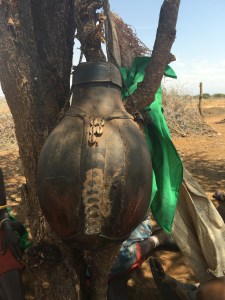
The nyatio is made from a large, round gourd rather than the more common carved wood most lmalasin are made from. It is cleaned with water or, preferably, cow’s urine rather than the burning botanicals used with other lmalasin. The urine is thought to help the milk separate. The nyatio is filled between one-half and two-thirds full. The two handles on either side, one longer than the other, facilitate hanging and shaking the container to churn butter. (Can you use camel milk? Leave your answer in the Comments below.] 

Hung from the center beam of the ngaji [Is this the mother’s hut? Leave remarks in Comments below], the nyatio is shaken to produce ngorno (butter).

Nyatio are made from a huge gourd purchased from the Massai, the gourd’s circumference being that of the circle defined by the arms of a big man. Rather than capped with a skin lid, the nyatio is topped by a wooden stopper, not hollow, which has been made from a light wood, such as loishimi.

Draft: used for churning butter, made of loishimi, gourd; the wooden stopper is made of loishimi and is not hollow (query fact check the stopper).  

Description

Container capacity: variable


Return to Types of Milk Containers.

This is the draft manuscript of the Samburu Milk Project, © 2024 William Rubel. 

lmala nkodoos (14)

Noun
Pronunciation: XXX
Calabash for milk, meat, or butter. 

Nkodoos, Samburu, Kenya
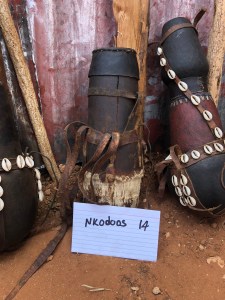
Nkodoos milk container; note the animal hair on the skin bottom.

The lmala nkodoos is carved out of lokudong’it and no other wood. It has a skin lid that also serves as a cup, and a skin bottom; it shares the latter feature with the seenderi. It is used as a collecting container, both for milking and for bleeding a cow. (Cow blood was mixed with milk in January and February to supplement the diet of children after the long rain ended, and to feed boys whose penis was recovering from being cut in the circumcision ceremony; see kule saroi.)

Description

Capacity: XXX liters

Nkodoos, Samburu, Kenya
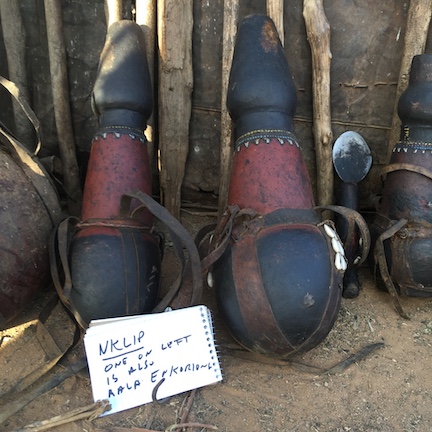
Nkodoos, flanked by larger lmalasin in the nklip class.

Cylindrical wooden vessel with a leather base and a cylindrical cup-shaped leather lid. The container’s neck is long, straight and pillar-like, and swell gently in circumference to a slightly wider leather base. The ratio between the base and the neck is roughly 1:1.2. The leather base secured in place with stitching. The container’s exterior is typically painted black (using ash mixed with animal blood). Leather carrying straps of varying widths encircle the vessel’s sides at its waist. The detachable lid is cup-shaped and made of leather. The lid’s flat leather top is nailed to the sides. The lid is also usually painted black. 


Return to Types of Milk Containers.

This is the draft manuscript of the Samburu Milk Project, © 2024 William Rubel. 

Nklip (12) — Distinguishing characteristics

Pronunciation: luh-mall-uh uhn-glip
Wooden container for milk that can be used by anyone, normally for milking.

Milk containers in the nklip class have:

  • A body carved from wood
  • A round bottom
  • A long neck
  • Usually a long lid, also carved from wood
  • Leather carrying straps

Some nklip are decorated with skirai (cowry shells) as a matter of personal preference. Skirai are purchased at the local market. The use of color is also a choice. Black is created by mixing ash with animal blood. Red is from lkaria (ochre).

Nklip, Samburu, Kenya.
Nklip, with human legs for scale.

An nklip has a leather collar stitched to the top of the wooden body to secure the lid; the lid’s rim slides inside the collar when stored in place on the body. The stitching at the collar is often decorative as well as functional, and this is also a matter of personal preference.

Lids also serve as cups. They are hollow and often carved of wood in an upside-down urn shape. The njongor is an exception; it has a woven lid. 

Most households have many nklip for milking, although with the decline in the quantity and quality of herds, households have downsized their collections of milking containers.

Description

Capacity: XXX liters

A medium to small container with a lid, used for milking, storing, and drinking milk. The cylindrical hollow body is carved from wood and has long, straight sides that swell outward gently below its neck to a swollen, rounded base. The vessel’s exterior is often painted black or stained red with ochre, and has decorative stitching at the top to secure a leather collar that holds the lid. Leather carrying straps of varying widths encircle the body. Ornamentation may include cowry shells, ochre, and a black paint made of ashes mixed with blood. The separate lid is often roughly urn-shaped, with sides that slope outward below a flat top to a low, rounded waist, then taper sharply at the bottom to fit inside the body’s leather collar. The lid can also be painted black or stained with ochre. 


Return to Types of Milk Containers.

This is the draft manuscript of the Samburu Milk Project, © 2024 William Rubel. 

Dedication

This work is dedicated to the many dozens of Samburu who, over a period of thirty years, took care of me, guided me, patiently answered my questions, reviewed manuscript entries over and over and over again. Thank you.

This work documents a culinary vocabulary of taste, aroma, and mouthfeel that far exceeds that of English, and I suspect nearly all other languages. The food itself, the smoke cured fermented milk, has been dismissed by observers from outside Kenya with two reductionist observations. The anthropological literature observes that the Samburu staple food is (was) milk. Travelers with published accounts of visiting the region going back to the 19th century have observed the Samburu drink “smoked milk.” In fact, the Samburu cuisine of smoke cured fermented milk is a cuisine of incredibly complexity and subtlety. And their Northern Maa vocabulary of taste and texture terms is exceedingly complex. Speaking as an English speaker, I can say that there are a large number of culinary ideas that the Samburu can discuss that we have no words for – or concepts. An example is xxxx, tasteless, and xxx, lacking its essence.

The Samburu smoke cured fermented milk is the quintessential poverty food that is dismissed by outsiders as a nothing.This work is dedicated to the generations of Samburu women whose lives revolved around preparing the milking container with burning sticks, a skill they began learning as small children. The work is tedious. It is also harmful to ones health. Eye and lung problems go hand-in-hand with the milk preparation.

Just before electricity came to the Wamba area I described a refrigerator to Elizabeth, one of the women who taught me how to make the milk, and who I stayed with on many occasions, even though we could not directly speak to each other. Through a translator, I described a refrigerator to Elizabeth. I told her that would keep milk cold so that it would last for a week or more. I asked her whether, if she had such a box, she would still clean the containers with burning sticks. Without any hesitation, “No.”

This work is dedicated to all of the Samburu women, and all of the women everywhere, in all times and places who, living lives with few material possessions created meals for their families with limited ingredients for which they were taken for granted. Their labor and skill assumed by their families and communities, and their work entirely over looked by outsiders who looked down on their foodways as too simple to bother with. It is to you that this work on one of the quintessential cuisines of poverty is dedicated.

The Samburu milk cuisine, infinitely nuanced, consists of the skill and connoisseurship of generations of women going back to the time of myths who skillfully created foods of distinction using wooden and gourd containers for production, selected botanicals to sterilize the containers, flavor and to preserve the milk, milk, of course, and time.

And, personally, this is dedicated to my mother under whose guidance I learned to pay attention to taste, aroma, and presentation. The skills I needed to recognize in my first sip of Samburu milk that there was a treasure passing between my lips.

Introduction: Smoke Cured and Fermented Milk

As soon as I had sipped my first sip of smoke cured and fermented milk prepared by the mother of my then friend, Lawrence Letua, I was hooked. It was my first night of my first return to Wamba, Kenya. 1994. I had disembarked from the roof of Baby’s Coach, the one vehicle that connected Wamba with the rest of Kenya via Isiolo and Archer’s post. With the Mathews Range to our right, for hours we bumped and crawled along the road, finally reaching Wamba in flurry of air horn music as the sun was setting in early evening. Every night being and early night so close to the equator. In the dark, there was no electricity in Wamba, and at that time flashlights were not common. There was a moon. We walked in the moon light to his mother’s stick and dung hut. I was ushered through the narrow low door, narrow so one had to bend and slide through at an angle, and was told where to sit in the pitch black interior. No lights of any kind. The hut a few meters in diameter and low. Only children can stand. I was not able to see the other people. Dark skinned people sitting it the dark. We made our introductions and then a hand handed me a wooden cup of milk. I sipped. And that was it. That was love at first sip. Such a delicious lightly smoked ineffably sweet taste, something like vanilla ice cream and a mouth feel that was not that of fresh milk, not a fully clabbered yoghurt, not the thickness of a cultured Kiefer, a mouthfeel that few of us have ever encountered, a milk with body, light, refreshing, with an utterly beguiling taste. 

I returned to Wamba nearly every year between 1994 and Covid, sometimes skipping a year, sometimes going twice. Since Covid, I have been back once, for my 70th birthday. I went back to finish this manuscript and to celebrate my birthday within the community I had developed a deep connection. I had five-hundred guests — one hundred of which were children — including a row of dignitaries — the wives of regional politicians who sat in seats in front of where everyone else was gathered, staring straight ahead, like people at a high table, which is what, in fact, they were. Around a dozen men and women came together in that summer of 2022 to help me complete the dictionary, the identification of the botanicals used in the processing of milk, and the containers into which milk was milked and/or fermented. This work can be understood as a community effort – the Samburu community working with me to document the pride of their culinary culture — a central aspect in how Samburu identified themselves. 

Times have changed. In the past, the field anthropologist would travel to a place, come back to their home, write it up, publish, and that was that. The many people who helped me with this project now all have phones. Several of them are people with whom I have maintained a relationship. There are also now large online communities of Samburu. We are posting this material towards the end of 2024. Throughout 2025 we will be working with people still living in Samburu County and living in the Samburu diaspora in other parts of Kenya, and the world, to correct errors and add details. The life that this work describes is no more. Between climate change and over grazing, the land no longer supports large herds, or even any herds of cows, and for so many right now, not even goats or sheep. Only camels. The countryside is depopulated. Manyattas, small collections of stick and dung huts are a rarity, now mostly associated with the outskirts of a small town, a school. It has been a long time since people have had the daily experience of drinking well prepared cows milk. Or even the experience of a single cup of milk in a year. Memories are fading. 

If you are Samburu and have anything to add to this work, or have corrections you’d like to make, please use the comments. If you’d like to speak with me, then let me know in your comment. The smoke cured and fermented milk cuisine of the Samburu is one of the world’s great milk cuisines. Together we can document it as it was, and then it will at least have a chance to find a new expression as the Samburu melt into the larger culture of Kenya, and the world.

lmala njongor (11)

Samburu lmala njongor, Wamba, Kenya

Noun
Pronunciation: XXX
Wooden lmala with a woven lid, used to hold milk for blessings conducted by either women or men.

The blessing milk is mixed with water. The diluted milk can be poured into the cap and then poured onto the ground. For example, when dedicating a building, the milk will be poured around the foundation perimeter. With somewhat more ritual, the blessing milk can also be poured onto a cow tail, or the tail can be dipped into the milk and then shaken onto the ground while rhythmically chanting ngai (God). The blessing might be conducted sitting or moving. Women walking into the mountains to pray under a sacred tree will dip leaves into milk and chant the blessing while walking to bless each tree found growing around pooled water in otherwise dry river beds. 

The njongor is also the girl’s lmala, although the distinction between this and the traditional boy’s lmala el laiyok is weakening. Each child has her own njongor.

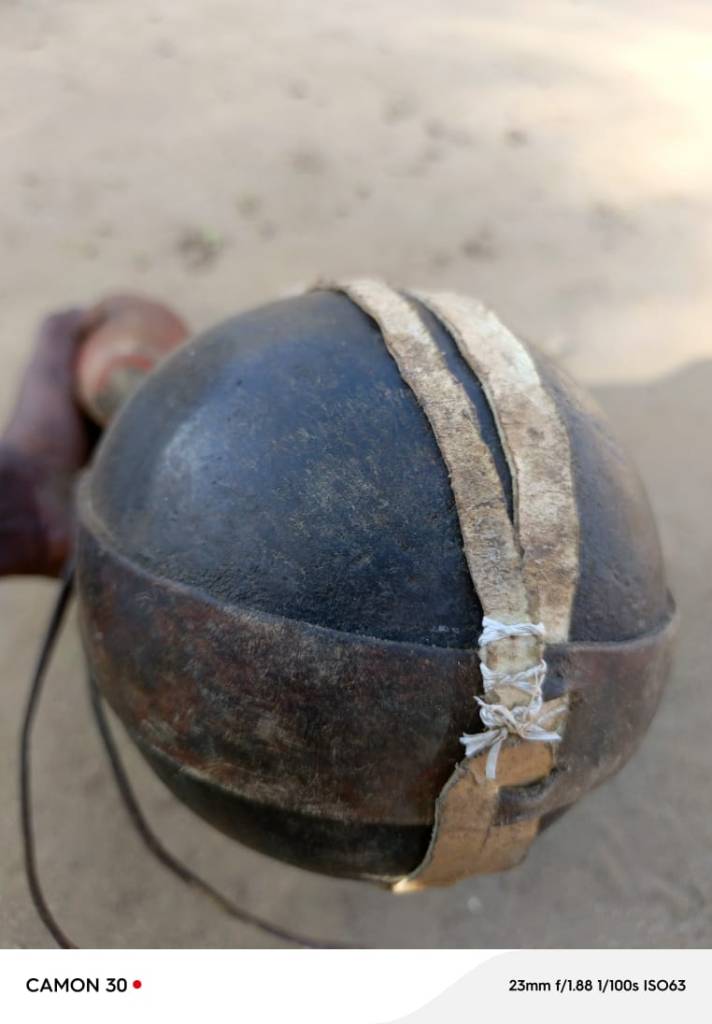
The njongor‘s lid is not carved from wood, as with other containers in the nklip group. Instead, it is woven of grass (the tan-colored bands in the photo above) and plastic sacks (the red bands in the photo).

The njongor is now rare in the Samburu Highlands and in communities near roads.

Description

Capacity: XXX liters

Cylindrical wooden vessel with a separate woven lid. The vessel’s long, straight sides swell outward gently below its neck to a swollen, rounded base. The vessel’s exterior is stained red with ochre or painted black (made from ash mixed with blood), and it has decorative leather stitching in white and green at its neck that support a collar. Leather carrying straps of varying widths encircle its sides. The straps are often decorated with skirai (cowry shells). The detachable lid is roughly urn-shaped and woven of grass ( Its sides slope outward from a flat top to a leather collar that slides over the vessel’s neck. 


Return to Types of Milk Containers.

This is the draft manuscript of the Samburu Milk Project, © 2024 William Rubel. 

lmala nkirau (13)

Samburu lmala knirau, Wamba, Kenya

Noun
Pronunciation: XXX
Gourd lmala with a hollow cup-shaped wooden lid, of varying sizes and shapes. The nkirau belongs to women, children, and elders, but is never used by murran (warriors).

The dried gourd is purchased from the Maasai. The Maasai use this gourd for milking, but the Samburu use it for milk storage and mixing. As gourds are fragile compared with wood, the nkirau is not filled around cows because it could easily be destroyed with a kick. 

The nkirau shares a style of flat-topped carved wooden cup with the lmala lkantir. With the nkirau, the angle at which the cap is expanded to its largest bulbous diameter is less sharp than in the lkantir; in other words, the walls of the cap as it descends from its flat top, while more angled, are more parallel than those of the lkantir, whose shape to my eye is one of remarkable elegance. The lid is often decorated with colorful stitching close to the rim.

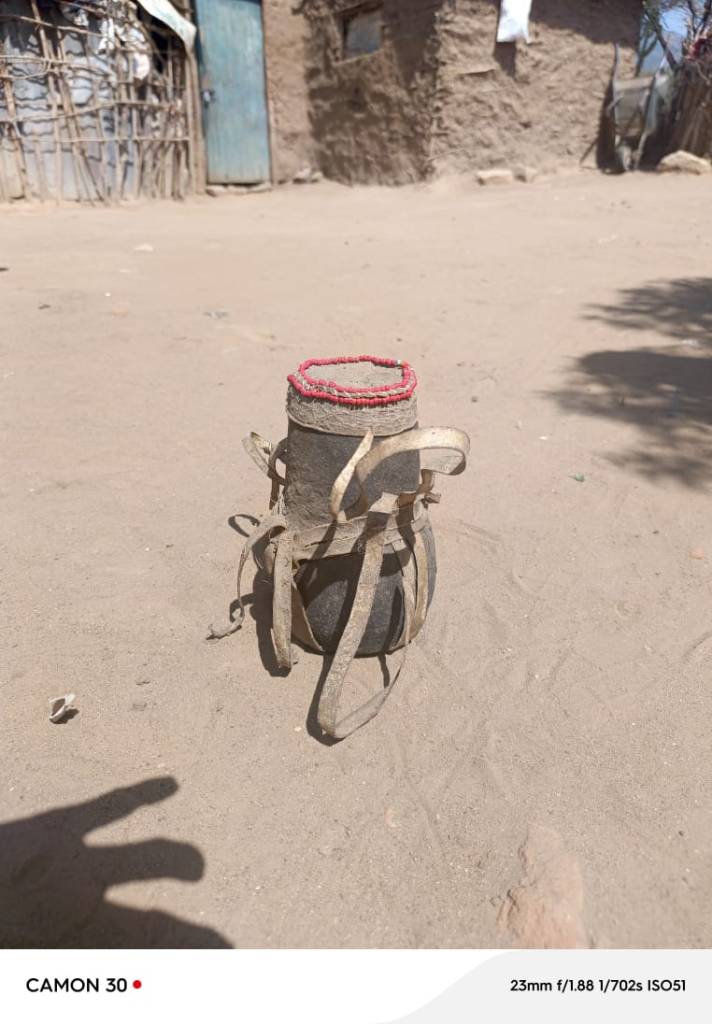
Turkana form of nkirau.
A Turkana form of nkirau. Samburu people will use this form of container, but they do not make it — and they would never drink Turkana-processed milk from it.

Few examples of nkirau remain, as it has been so long since enough cows existed to produce enough milk to fill one. With the apparent definitive collapse of Samburu herds as I write this in the summer of 2022, the shape likely will never be used again. The same is true of the lmala nyatio, which has the circumference of the arms of a big man; my Samburu friends estimate it has not been used since the drought of 1986. 

The nkirau is very similar to the lmala naililiori except it has only a single side band running up the base to the waist belt. 

Description

Container capacity: XXX

Cylindrical gourd container with urn-shaped wooden lid. The vessel’s sides swell outward below its neck to bulbous shoulders, then taper inward to a swollen rounded base. The container’s exterior is stained with ochre and has decorative leather stitching encircling its top. Leather carrying straps of varying widths encircle its sides at the waist and support the base. The detachable carved wooden lid is roughly urn-shaped, with sides that slope to a rounded waist, then taper sharply to fit over the gourd’s neck. The lid is usually painted black using animal blood mixed with ash, but is otherwise undecorated. 


Return to Types of Milk Containers.

This is the draft manuscript of the Samburu Milk Project, © 2024 William Rubel. 

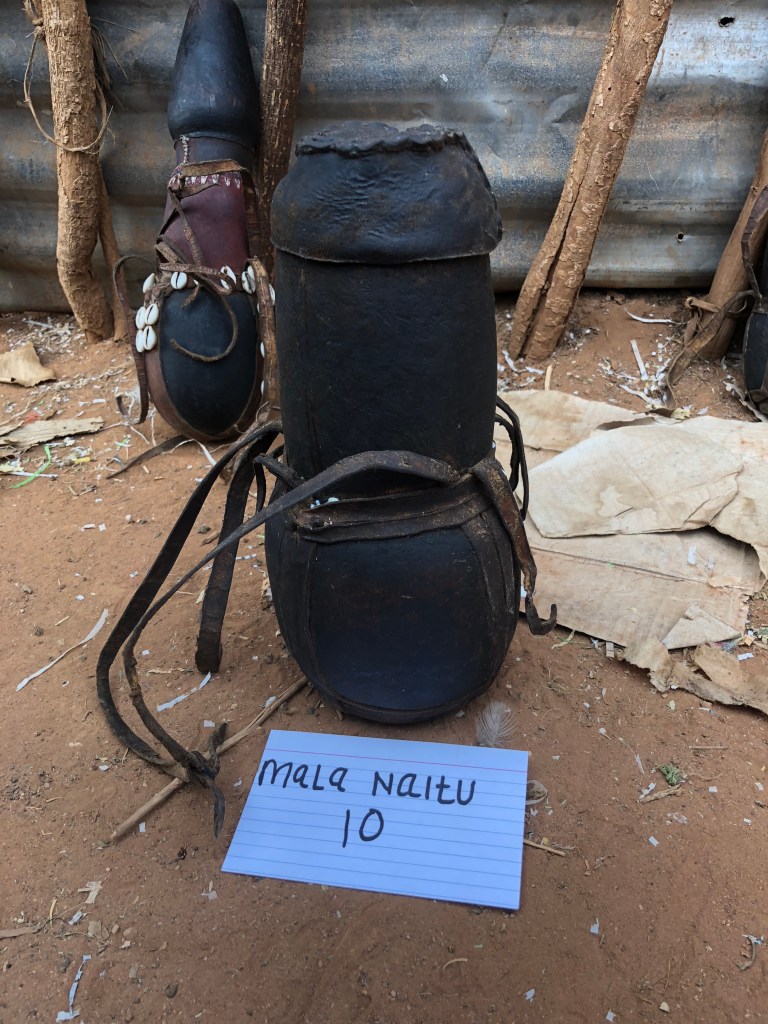
lmala naitu (10)

Noun
Pronunciation: ehn-eye’-too
Small- or medium-sized multi-purpose lmala used for milking, drinking, holding blood harvested from the cow, by women and by children.

What makes a naitu different from an nklip, but related? The naitu is made of wood, has a bulbous base and straight neck like nkelip, though the base may less bulbous and may be flat bottomed. As the plastic, woven, or leather lid fits directly over the neck, there is no stichking or leather collar. Ocre and cowery shells are associated with some naitu, but not with all naitu.

The naitu has a leather or woven cup. The body’s neck is narrower than those lmala in the nklip group, and the ratio of neck to bulb-shaped base is reduced. When the container’s shape is the same but its cup is plastic, then the lmala is known as an nkerai.

Women use this type of lmala for their entire lives. Children begin to use the naitu when their appetite grows, usually at about the age of six. The naitu is also used to fetch the circumcision water on the morning of that ceremony. Circumcision takes place when a new Age Set is declared. At that point, boys are initiated into the murran (warrior) stage of life and they shift to using the lmala loolmuran

Three different types of naitu exist:
1) Naitu elpayan – a husband’s naitu made by his wife when they are first married.
2) Naitu nang’orchierekia smaller naitu for the measure of one collection of blood bled from a cow for mixing with milk to make kule njuloti and kule saroi.
3) Naitu elayioka boy’s lmala that he carries with him when the cattle move away from the manyatta.

Description

Capacity: XXX liters

Cylindrical wooden vessel with a detachable leather lid. The hollow body’s straight sides swell outward gently below its rim to a slightly swollen, rounded base with a flat bottom. The vessel’s exterior is painted black. Leather carrying straps of varying widths encircle its sides at the waist and support the base. Unlike some other lmalasin types, the naitu‘s body has no leather collar, so the lid rests on top of the container. The lid, which also serves as a cup, can be made of leather or woven of grass and plastic sacks. The lid is often painted black. 


Return to Types of Milk Containers.

This is the draft manuscript of the Samburu Milk Project, © 2024 William Rubel. 

lmala nairoshi (9)

Noun
Pronunciation: XXX
Heavy lmala that is large and can hold a lot of milk. Its purpose is to collect milk. This is the only lmala that can be used by anyone — children, grownups, men, women, elders, and guests. [This is the same basic definition as the nklip. Is this correct? Leave your remarks in Comments below.]

The nairoshi has no social distinction, so it is interesting to note that its basic shape and coloration come from outside the Samburu culture. Its core is painted over in patterns usually associated with the Turkana. The lid or cap is distinctively Turkana. Ochre is painted around the top of the cup, the flared hat part, and then four wide vertical bands down to the slightly outwardly curved base, leaving four black rectangles. A similar pattern is repeated below, with the black rectangles being more square than rectilinear. What makes the nairoshi decoration Samburu is the use of skirai (cowry shells) on the leather straps. 

Description

Capacity: 1 to 1 1/2 liters

Cylindrical storage vessel with a leather cap. Colored stitching ending in downward-pointing triangles holds the inner leather lip in place. The line from the base to the top of the lmala is almost straight, though there is a slight outward curve at the bottom, just before the cap is reduced to fit within the mouth of the main container. The main part of the cap is a cylinder, wider at the base than the top. What makes the cap distinctively Turkana is that before the main portion of the cup narrows it again angles out forming a hat with a flared rim. The main part of the cap is a cylinder that is wider at the base than at the top, with a slight outward curve at the bottom, just before the cap is reduced to fit within the mouth of the vessel. 


Return to Types of Milk Containers.

This is the draft manuscript of the Samburu Milk Project, © 2024 William Rubel.