Pronunciation: seh-kee’-tee
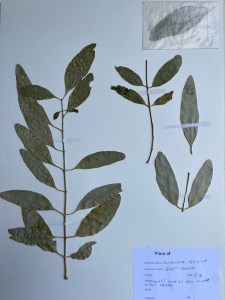
Botanical name: Salvadora persica
Description: Pictured specimen collected in June, 2016. Habitat: Under trees close to the dry Lengusake River, where it passes behind Lengusaka, Kenya. “An evergreen shrub or small tree to 6-7 m; main trunk erect or trailing with profusely branched, wide crown of crooked, straggling and drooping branches. … S. persica is widespread, notably in thorn shrubs, desert floodplains, river and stream bank vegetation, and grassy savannahs. Prefers areas where groundwater is readily available. … Also found in valleys, on dunes and on termite mounds.”
Uses: “[Fruits] can be eaten raw, cooked, or dried and stored. … The leaves are also cooked as a sauce and eaten with couscous or as a green vegetable. … Leaves and young shoots are browsed by all stock, but normally cattle do not occur in the driest part of the S. persica distribution range and hence it tends to be valued more as a camel, sheep and goat forage. Leaves make good fodder as their water content is high (15-36%). The high salt content of the leaves is said to affect the taste of milk, but the leaves are said to increase lactation in cows. … The wood is sometimes used for firewood and charcoal. However, it is not used for cooking meat, as it leaves a foul taste. Timber: The wood is soft, white, easy to work and is not liable to termite attack.”
Source: Orwa C, A Mutua, Kindt R , Jamnadass R, S Anthony. 2009 Agroforestree Database:a tree reference and selection guide version 4.0. http://www.worldagroforestry.org/sites/treedbs/treedatabases.asp (accessed 7/18/24)
Return to Botanicals for Lmala Preparation.
This is the draft manuscript of the Samburu Milk Project, © 2024 William Rubel.

 Samburu Research