Pronunciation: XXX
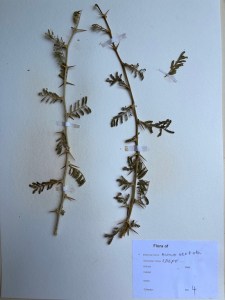
Botanical name: Acacia oerfota, Fabaceae family (Acacia nubica on Alois Plant List)
Description: Pictured specimen collected near Lengusaka, Kenya. “Commonly occurs in deciduous bushland and semi‑desert scrub from Egypt, the Sudan and Eritrea and into Kenya. … A [thorny] shrub to 5 m, branching from the base, irregular or flat topped.”
Uses: “Firewood, poles (hut frames), medicine (bark), fodder (leaves, twigs, pods), fibre (bark). … A bark extract is used to treat rheumatism.”
Source: Bekele-Tesemma, Azene. Useful Trees and Shrubs of Ethiopia. Nairobi, Kenya: World Agroforestry Centre, 2007. https://apps.worldagroforestry.org/usefultrees/pdflib/Acacia_oerfota_ETH.pdf (accessed July 2024).
Return to Botanicals for Lmala Preparation.
This is the draft manuscript of the Samburu Milk Project, © 2024 William Rubel.
Published by William Rubel
I am an author who writes about traditional food and foodways. My book, The Magic of Fire (2002) is about hearth cooking. I have written an introductory history of bread, Bread, a global history (2011) and am currently writing a history of bread for the University of California Press. Other areas of interest include wild mushrooms, and specifically the treatment of Amanita muscaria in the historic record. I also write about Early Modern British Gardens, and for a more general audience, I write for Mother Earth News on bread, gardening, and more. I have an ongoing research project into the smoke-cured fermented milk of the Kenyan Samburu tribe. I am a co-director of the Samburu Lowlands Research Station, Lengusaka. I am the founding editor (1972) of Stone Soup, the magazine of writing and art by young people.
View all posts by William Rubel

 Samburu Research