Noun
Pronunciation: XXX
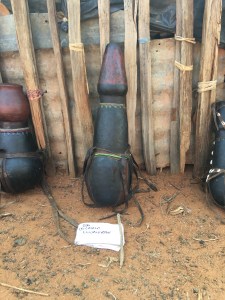
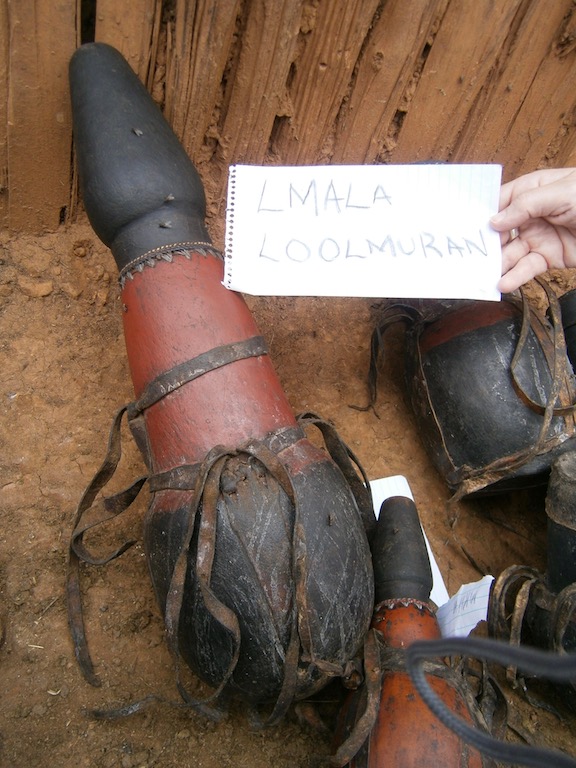
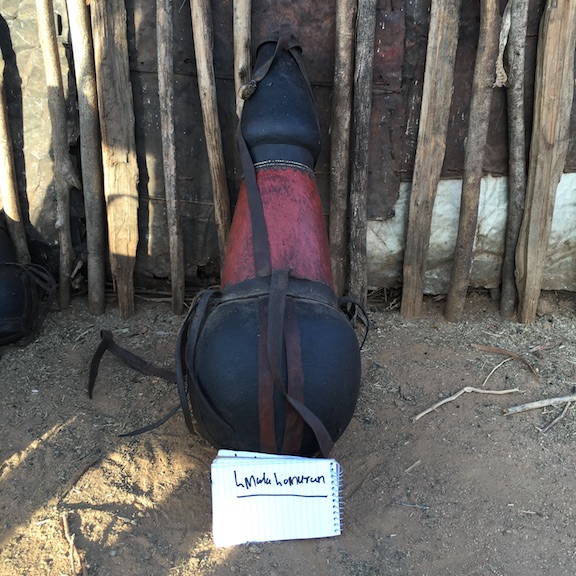
The only lmala the murran (warriors) drink from. A very large wooden lmala with a hollow cup that also acts as a lid.
The loolmuran is an nklip and has that group’s basic shape — a bulbous base, and a straight section that is at least as long as the bulbous portion and usually a little longer. The stitching pattern holding the leather in place at the neck into which the wooden lid is tightly fitted is the same as for the nklip and other lmalasin, except in this unique case, the color of the bottom triangular-shaped stitching is green. In Samburu culture, green is associated with boys, unlike in many Eurocentric cultures, where blue is associated with boys and pink with girls.
Because the loolmuran is so large, it is made of a lighter wood, such as bolorio. As with the lmala seenderi, the wood on the loolmuran‘s lid and its straight neck section are often colored red with ochre. The color and pattern are not prescribed. The neck and cup can be read as a phallic shape; the lid, which fits into a leather sleeve, is shaped like the tip of an erect penis. A lmala loolmuran is larger than a typical nklip. Its leather carrying straps are never decorated, so it projects a sense of raw strength and power.
When milk was plentiful before the beginning of the modern drought cycles in 1972, a loolmuran’s capacity could be as large as 10 liters. Today, the average size is about 5 liters, but it can also be smaller, because it is defined by its shape and decorations and not its size. Since it is so large, the loolmuran is made of a lighter wood, such as bolorio.
Before being circumcised, boys wear a sainanyori (single-strand necklace of small, green glass beads). One finds a sainanyori around the necks of babies at about six months, just as in Mexican culture, for example, girl babies get their ears pierced. One knows a Samburu infant is a boy in the same way one knows a Mexican infant is a girl — by their jewelry. After the initiate boy has been circumcised and is led back into his mother’s hut for his penis to heal, the first thing that happens is that the sainanyori is removed from his neck and slipped over the neck of the lmala loolmuran [Is there a loolmuran in every mother’s hut, or just in the warriors’ huts? Leave your remarks in Comments below]. It stays there for seven to 10 years. No ceremony exists for removing the sainanyori. At some point, the mother decides it is time to remove it, typically after the boy has grown a lot and is transitioning to the next stage in life, which is as an elder. [What happens to the sainanyori after the boy becomes an elder? Leave your remarks in Comments below]
Description
Capacity: 5 liters on average
Cylindrical wooden vessel with an urn-shaped wooden lid. The vessel’s long, straight sides swell outward gently below its neck to a bulbous rounded base ornamented with carved designs. The vessel’s exterior is painted black or stained red with ochre, and it has decorative leather stitching in white and green at its neck that support a leather collar. Leather carrying straps of varying widths encircle its sides at the waist and support the base. It is not uncommon for the straps to retain some animal hair. The separate carved wooden lid is roughly urn-shaped, with sides that slope outward below a rounded top to a low, rounded waist, then taper sharply at the bottom to fit over the vessel’s neck. The lid also can be painted black or ochre-stained, but is otherwise undecorated.
Return to Types of Milk Containers.
This is the draft manuscript of the Samburu Milk Project, © 2024 William Rubel.

 Samburu Research