Noun
Rel. lmala kini enkerai, n.
Pronunciation: ehn’-ghee-ahr-ee-eye
The nkerai is a class of lmala that includes the enkoriong, the woman’s wedding lmala. That becomes the kini enkerai when a girl child reaches the age of six or so and needs more milk than the nkerai — after weening until they need more milk at a serving.
This group of lmalasin is reserved for boys once they are old enough to start drinking cow’s milk.
The small lmala that accompanies a bride becomes her child’s lmala. But normally the first newborn uses lmala naitu, which have a skin cup rather than a wooden cup. Children first from the skin because they don’t know how to drink without pouring milk.
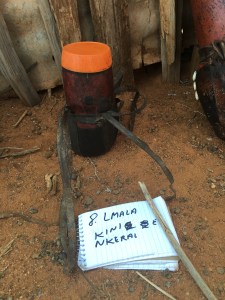
The enkerai is among the smallest vessels in the nkoiting class of lmalasin. Enkerai come in two sizes: the lmala enkerai, with a capacity of about 500ml, and the lmala kine enkerai, which is equivalent to the sippy cup I gave to my infant daughter.
Enkerai are milk containers for infants of about six months, as they begin to supplement their mother’s milk with lmala milk. The lmala nkerai is used until the child’s appetite increases to the point an nklip or larger is more practical.
Description
Capacity: about one glass of milk
Cylindrical wooden vessel with a cup-shaped plastic lid. The vessel’s short, straight sides swell outward gently below its waist to a rounded, slightly swollen base.
The vessel’s exterior is painted black or stained red with ochre. Leather carrying straps encircle its sides at the waist and support the base. The separate lid is roughly cup-shaped, with sides that slope outward below a flat top, and fits over the vessel’s neck. The lid also can be painted black or ochre-stained, but is otherwise undecorated.
Return to Types of Milk Containers.
This is the draft manuscript of the Samburu Milk Project, © 2024 William Rubel.

 Samburu Research