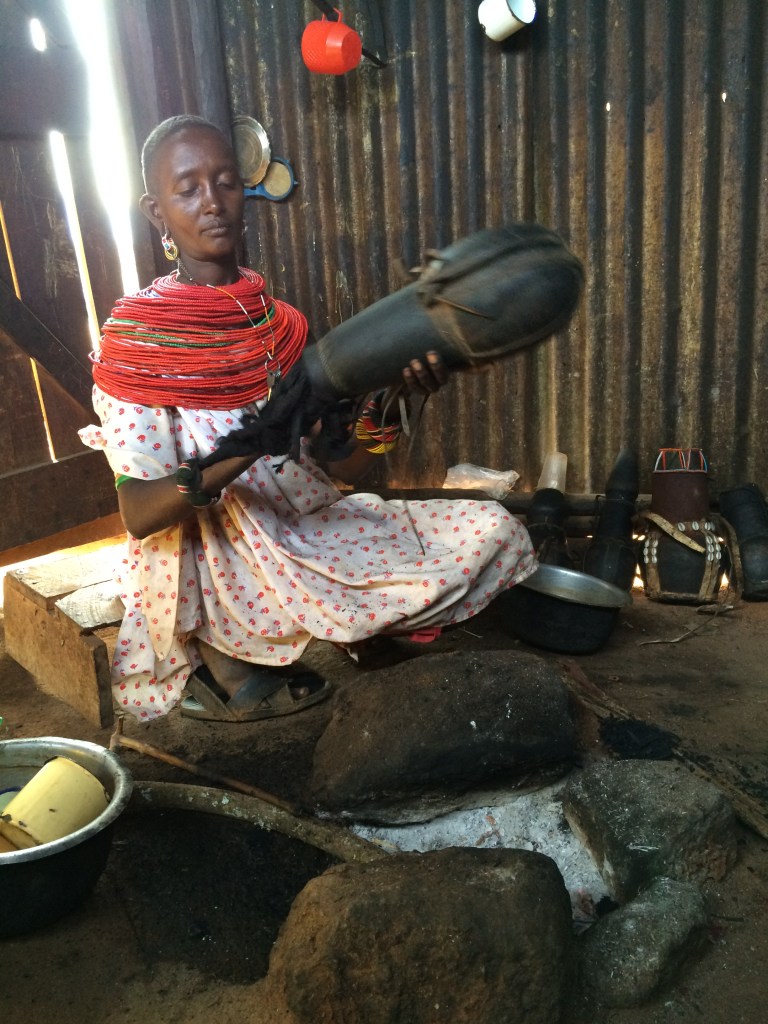
Samburu woman cleaning a lmala — milking container
This wooden hand carved lmala, milking container, has just been sterilized with burning sticks. What we see here is the process in which the container is wiped to eliminate embers and ash.
The Samburu do not like milk with bits of ember or ash in it. Other tribes in the region serve milk with black specks from the process of sterilizing with burning sticks, so preference for a milk that is totally clean, totally white when poured , which is how most of the world prefers the milk, in this context is a cultural preference amongst the Samburu. Their white milk – and the milk will be left in the lmala to ferment to one of their preferred stages of consumption – differentiates it from some of the milks from other nearby tribes, like the Turkana.
This woman, and I apologize for forgetting her name, is the wife of Chief Stephen Loldepe. I have stayed with her. They live in a concrete house. This is an outdoor kitchen retaining the three rock kitchen fire emplacement common to the manyatta stick huts.
Samburu have long been semi-nomadic pastoralists, so their traditional buildings can be disassembled, with the larger stick used for the hut framework can be re-used. This is a modern outdoor kitchen with tall galvanized walls.
I am an author who writes about traditional food and foodways. My book, The Magic of Fire (2002) is about hearth cooking. I have written an introductory history of bread, Bread, a global history (2011) and am currently writing a history of bread for the University of California Press. Other areas of interest include wild mushrooms, and specifically the treatment of Amanita muscaria in the historic record. I also write about Early Modern British Gardens, and for a more general audience, I write for Mother Earth News on bread, gardening, and more. I have an ongoing research project into the smoke-cured fermented milk of the Kenyan Samburu tribe. I am a co-director of the Samburu Lowlands Research Station, Lengusaka. I am the founding editor (1972) of Stone Soup, the magazine of writing and art by young people.
View all posts by William Rubel

 Samburu Research